1. Introduction
In today’s digital era, Artificial Intelligence (AI) has become one of the most transformative technologies. At its core, AI refers to the ability of machines and computer systems to simulate human intelligence—learning from data, processing information, and making decisions. From virtual assistants on our smartphones to self-driving vehicles, AI is rapidly changing how we live and work.
2. Key Applications of AI
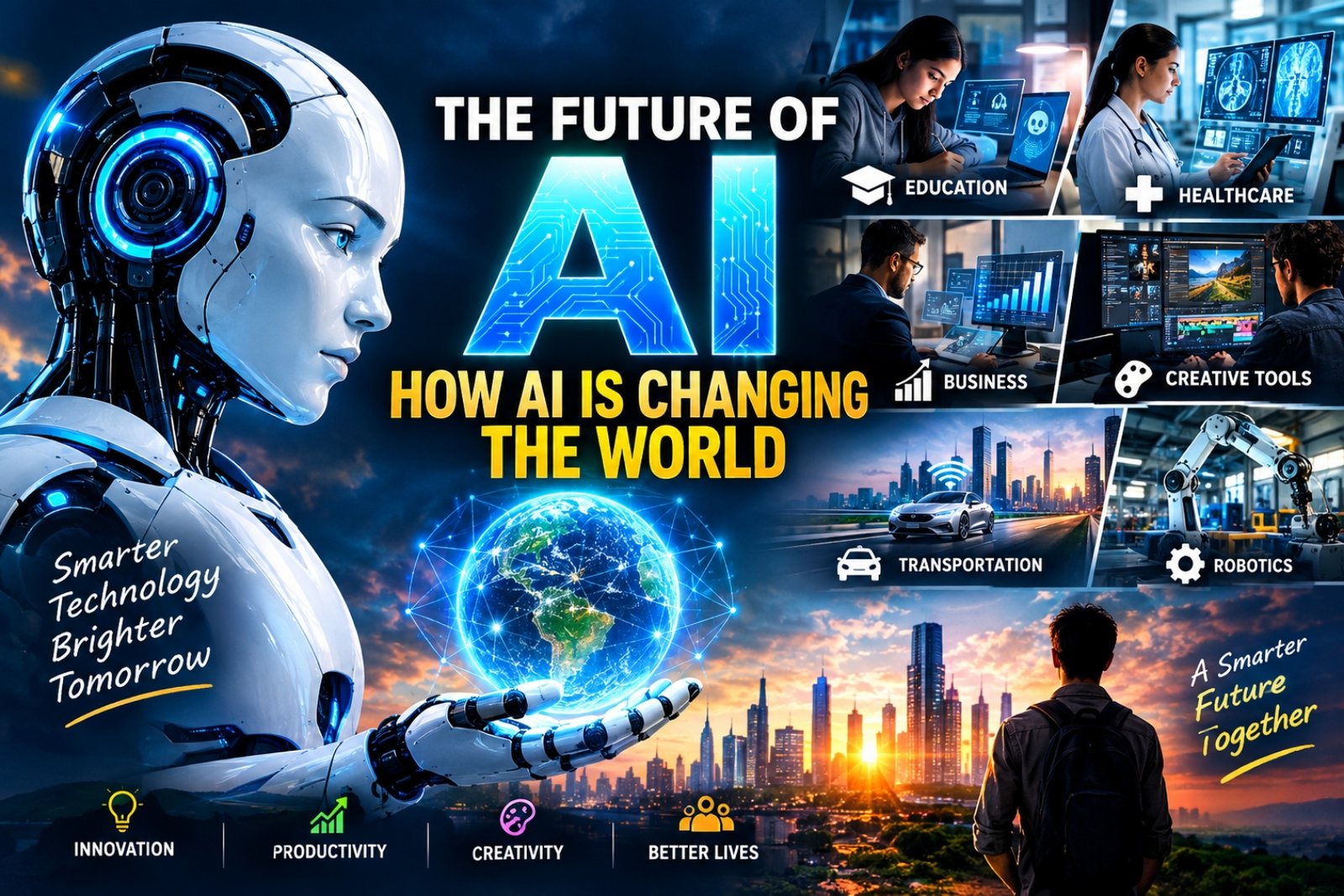
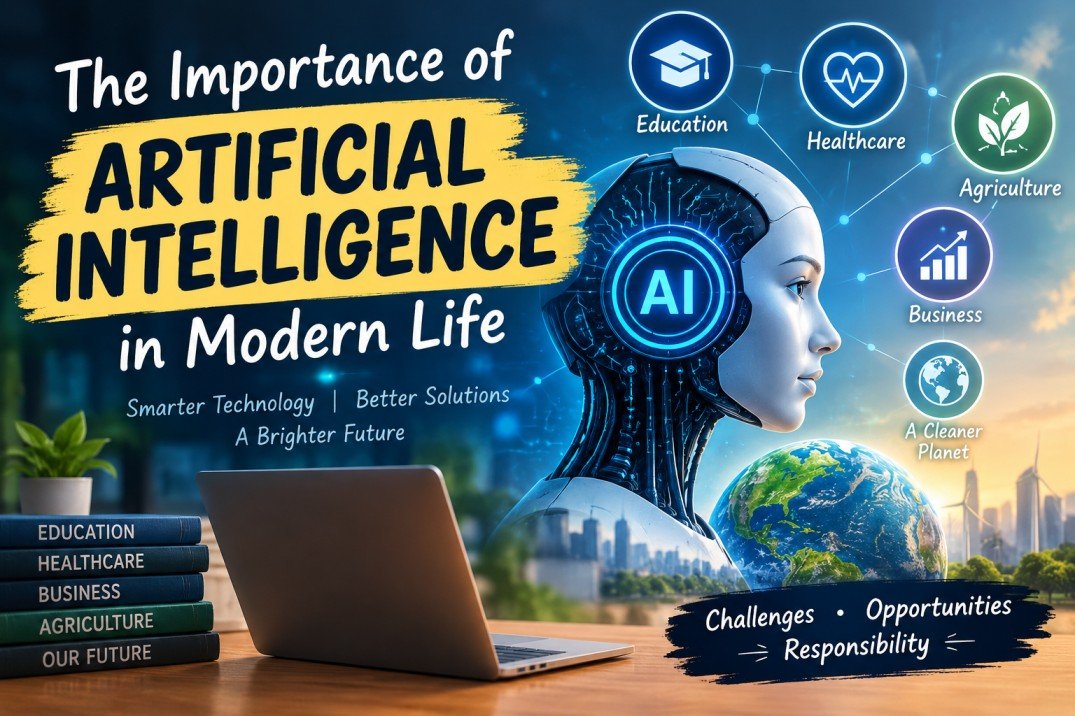
Healthcare: Assisting doctors in disease diagnosis, analyzing complex medical imaging, and accelerating drug discovery.
Education & Research: Providing personalized learning experiences, automated tutoring, and smart research assistance.
Business & Industry: Streamlining workflows, automating repetitive tasks, and enabling data-driven decision-making.
Everyday Convenience: Powering navigation tools like Google Maps, content recommendation engines, and smart home systems.
3. Key Benefits and Challenges
Benefits: Increases efficiency, minimizes human error, operates continuously without fatigue, and accelerates scientific innovation.
Challenges: Data privacy concerns, potential job market shifts, cybersecurity risks, and the need for ethical AI regulation.
4. Conclusion
Artificial Intelligence is not a replacement for human capability, but rather a powerful tool designed to augment it. By leveraging AI responsibly, society can solve complex challenges and build a more efficient, technology-driven future.
Artificial Intelligence: Shaping the Future of Global Technology
Introduction
Artificial Intelligence (AI) has emerged as one of the most defining technological innovations of the twenty-first century. From simple rule-based automation to sophisticated deep learning models capable of reasoning, creative content generation, and autonomous decision-making, AI is fundamentally altering how humans interact with technology, conduct business, and solve global challenges.
At its core, Artificial Intelligence refers to the simulation of human intelligence processes by computer systems. These processes include learning (acquiring information and rules for using it), reasoning (using rules to reach approximate or definite conclusions), and self-correction. As compute power expands, algorithmic architecture improves, and digital data generation accelerates, AI has transitioned from a theoretical computer science subfield into a core engine of the modern global economy.
The Historical Evolution of Artificial Intelligence
The foundational ideas of modern AI trace back to the mid-twentieth century when computer pioneer Alan Turing posed a simple yet profound question: "Can machines think?" Turing proposed what is now known as the Turing Test, a measure of a machine's ability to exhibit intelligent behavior indistinguishable from that of a human.
The Birth of AI (1950s–1970s): The field was formally founded at the Dartmouth Conference in 1956, where visionaries like John McCarthy, Marvin Minsky, Nathaniel Rochester, and Claude Shannon coined the term "Artificial Intelligence." Early work focused on symbolic logic, problem-solving, and theorem proving.
The AI Winters: During the late 1970s and late 1980s, high expectations collided with hardware limitations and algorithmic constraints, leading to funding cuts known as "AI Winters." These periods taught researchers the necessity of combining statistical approaches with scaled computing.
The Resurgence and Big Data Era (2000s–Present): The rise of the internet provided massive datasets, while GPUs (Graphics Processing Units) delivered the raw processing power required to train complex mathematical models. Deep Learning emerged, leading to breakthroughs in speech recognition, image classification, and natural language processing.
Core Capabilities and Types of AI
Artificial Intelligence is classified along two main axes: functional capability and operational scope. Understanding these distinctions helps clarify what AI can achieve today and where future research is heading.
1. Classification by Scope
Artificial Narrow Intelligence (ANI): Also known as Weak AI, ANI is designed and trained to complete a specific task. Current commercial AI systems—including recommendation engines, language translators, image generators, and facial recognition—fall into this category.
Artificial General Intelligence (AGI): Often referred to as Strong AI, AGI represents a hypothetical system that possesses the capability to understand, learn, and apply knowledge across any intellectual domain at a level equal to a human.
Artificial Superintelligence (ASI): A theoretical state where machine intelligence surpasses human capability across every field, including scientific creativity, general wisdom, and social skills.
2. Functional Categories
Reactive Machines: Basic systems that respond to current inputs without relying on past experiences (e.g., IBM's Deep Blue chess engine).
Limited Memory: Systems capable of using historical data to inform short-term future decisions (e.g., self-driving vehicles tracking surrounding cars over time).
Theory of Mind & Self-Awareness: Theoretical concepts where machines understand emotional states, social contexts, and ultimately develop self-reflective consciousness.
Key Technological Foundations
Modern Artificial Intelligence relies on a stack of computational frameworks, data structures, and mathematical concepts.
Machine Learning (ML)
Machine Learning is a subset of AI that enables systems to learn and improve from experience without being explicitly programmed. Instead of hardcoding instructions, engineers feed data into ML algorithms that construct predictive models.
Supervised Learning: Algorithms train on labeled data (input-output pairs) to learn maps between inputs and targets (e.g., spam detection).
Unsupervised Learning: Systems analyze unlabeled data to discover hidden patterns, clusters, or underlying structures (e.g., customer segmentation).
Reinforcement Learning: Agents learn optimal actions through trial and error within a simulated environment using a reward and penalty system (e.g., autonomous gameplay, robotics control).
Deep Learning and Neural Networks
Deep Learning uses artificial neural networks inspired by the biological architecture of the human brain. These networks consist of multiple layers of interconnected nodes (neurons) that process features at progressive levels of abstraction.
Convolutional Neural Networks (CNNs): Specialized for computer vision, image recognition, and spatial feature processing.
Recurrent Neural Networks (RNNs) & LSTMs: Tailored for sequential data analysis, time-series forecasting, and early speech processing.
Transformers: The modern architecture that replaced RNNs for sequential processing. By utilizing self-attention mechanisms, transformers can evaluate relationships between distant data points simultaneously, forming the backbone of modern Large Language Models (LLMs).
Industrial Applications Across Major Sectors
AI has transitioned from theoretical research laboratories into practical, real-world deployment across every major global market.
Key Challenges, Risks, and Ethical Considerations
While the benefits of AI are vast, its rapid deployment brings technical, economic, and moral challenges that demand careful governance.
1. Data Privacy and Security
AI systems require massive amounts of data for training. Collecting personal, financial, and medical records raises fundamental concerns regarding consent, data ownership, and surveillance risks. Furthermore, malicious actors can deploy adversarial attacks to manipulate model outcomes or extract sensitive training data.
2. Algorithmic Bias and Fairness
Machine learning models reflect the characteristics of the data used to train them. If historical training data contains systemic human biases, the resulting AI models can amplify unfair treatment in hiring decisions, law enforcement risk assessments, loan approvals, and healthcare allocation.
3. Economic Disruption and Workforce Transitions
Automation powered by cognitive AI tools is changing workplace requirements across both white-collar and blue-collar sectors. While new technical roles are created, existing routine tasks face disruption, requiring large-scale workforce reskilling and economic policy adjustments.
4. Hallucinations and Model Reliability
Complex deep learning architectures—particularly Large Language Models—can present false or inaccurate information with high confidence, a phenomenon known as "hallucination." Ensuring verifiable truth and reliable outputs in high-stakes fields like medicine and law remains an ongoing research challenge.
Future Outlook: What Lies Ahead
As research continues to accelerate, several key trends will define the immediate and long-term trajectory of Artificial Intelligence.
Multimodal Intelligence: Future models will natively synthesize speech, text, code, imagery, video, and spatial sensory data in real time, enabling seamless human-computer interaction.
Edge AI: Processing algorithms locally on mobile devices, IoT hardware, and local hardware rather than relying on cloud datacenters, resulting in faster response times and improved privacy.
Autonomous AI Agents: Transitioning from passive tools that answer queries to proactive digital agents capable of executing complex multi-step workflows, planning itineraries, managing software deployments, and negotiating operational logistics independently.
Sustainable AI Computing: Reducing the immense energy and water requirements of training super-large neural networks by developing efficient hardware architectures, specialized chips, and sparse model designs.
Conclusion
Artificial Intelligence is more than just a technological trend; it is a fundamental shift in how human civilization processes information and solves problems. By amplifying human capability, automating complex operational tasks, and accelerating scientific discovery, AI holds the potential to help address humanity's greatest challenges—from curing chronic diseases to optimizing clean energy grids. Achieving this potential requires balancing technical innovation with ethical oversight, thoughtful policy, and user-focused execution
Healthcare Diagnostic imaging analysis, predictive disease modeling, robotic surgery, automated drug discovery Faster diagnosis, personalized treatment plans, accelerated pharmaceutical development
Finance Algorithmic trading, automated fraud detection, credit risk assessment, personalized banking assistants Reduced operational risk, faster transaction processing, enhanced security
Automotive Autonomous driving algorithms, predictive vehicle maintenance, supply chain optimization Improved road safety, reduced traffic congestion, optimized fuel consumption
Retail & E-Commerce Hyper-personalized product recommendations, dynamic pricing models, automated inventory management Increased customer retention, optimized supply chains, lower operational overhead
Education Intelligent tutoring systems, automated grading, personalized learning path generation Adaptive learning speeds, reduced administrative burden for educators
Manufacturing Predictive equipment repair, quality assurance computer vision, smart factory robotics Reduced
Understanding Artificial Intelligence: The Technology Transforming Our World
Artificial Intelligence (AI) has shifted from a futuristic concept into an everyday reality. From smart assistants on our mobile phones to automated systems in healthcare and finance, AI is reshaping how we live, work, and interact with technology. At its core, Artificial Intelligence refers to computer systems designed to mimic human cognitive functions such as learning, reasoning, problem-solving, and decision-making.
As digital data continues to expand and computational power accelerates, AI technology is evolving at an unprecedented pace, making it essential to understand its capabilities, benefits, and future direction.
Core Capabilities: How AI Works
Modern Artificial Intelligence operates on advanced mathematical algorithms and massive datasets. Instead of following rigid, pre-written rules, AI systems analyze data patterns to improve their output continuously.
Machine Learning: A subset of AI where systems learn from historical data to make accurate predictions or classifications without explicit programming.
Deep Learning: An advanced form of machine learning that uses artificial neural networks—modeled after the human brain—to analyze complex data like images, audio, and video.
Natural Language Processing: Enables computers to understand, interpret, and generate human language, powering translation tools, chatbots, and writing assistants.
Key Real-World Applications
AI is actively transforming major industries across the globe by improving efficiency and uncovering new possibilities.
Key Benefits and Ongoing Challenges
While Artificial Intelligence offers remarkable opportunities, it also introduces important challenges that demand careful consideration.
The Benefits
High Efficiency: AI handles repetitive, time-consuming tasks automatically, freeing human workers to focus on creative problem-solving.
24/7 Availability: Automated systems can operate continuously without fatigue or performance degradation.
Data Insights: AI can process vast amounts of unstructured data instantly, revealing valuable trends and operational insights.
The Challenges
Data Privacy: Training AI models requires extensive data, raising concerns over consumer privacy and security.
Algorithmic Bias: If training datasets contain historical biases, the resulting AI outputs can perpetuate unfair results.
Workforce Shifts: As automation increases, industries must invest in reskilling workers for technical and strategic roles.
The Future Ahead
The trajectory of Artificial Intelligence points toward greater integration and smarter automation. Emerging developments focus on creating more versatile multi-modal models capable of processing text, voice, and vision simultaneously. Furthermore, making AI systems more energy-efficient and transparent will remain a top priority for developers and policymakers alike.
Rather than replacing human intelligence, AI serves as a powerful multiplier. By leveraging AI responsibly, society can solve complex challenges, streamline workflows, and unlock new avenues of human innovation.
The Essentials of Artificial Intelligence
Artificial Intelligence (AI) is transforming modern technology by enabling machines to perform tasks that typically require human intellect. Powered by advanced Machine Learning algorithms and Neural Networks, AI systems analyze vast amounts of data to learn patterns, make predictions, and adapt to new inputs in real time.
Today, AI powers crucial applications across various industries, including medical diagnostics in healthcare, fraud detection in banking, personalized recommendations in e-commerce, and autonomous driving in transportation. Its primary advantages lie in high-speed data processing, continuous 24/7 operation, and automated precision.
However, the widespread adoption of AI presents notable challenges, such as data privacy concerns, potential algorithmic bias, and workforce adjustments due to automation. Ultimately, Artificial Intelligence is designed not to replace human capability, but to enhance it—serving as a powerful tool to drive scientific discovery, optimize complex workflows, and solve global challenges.