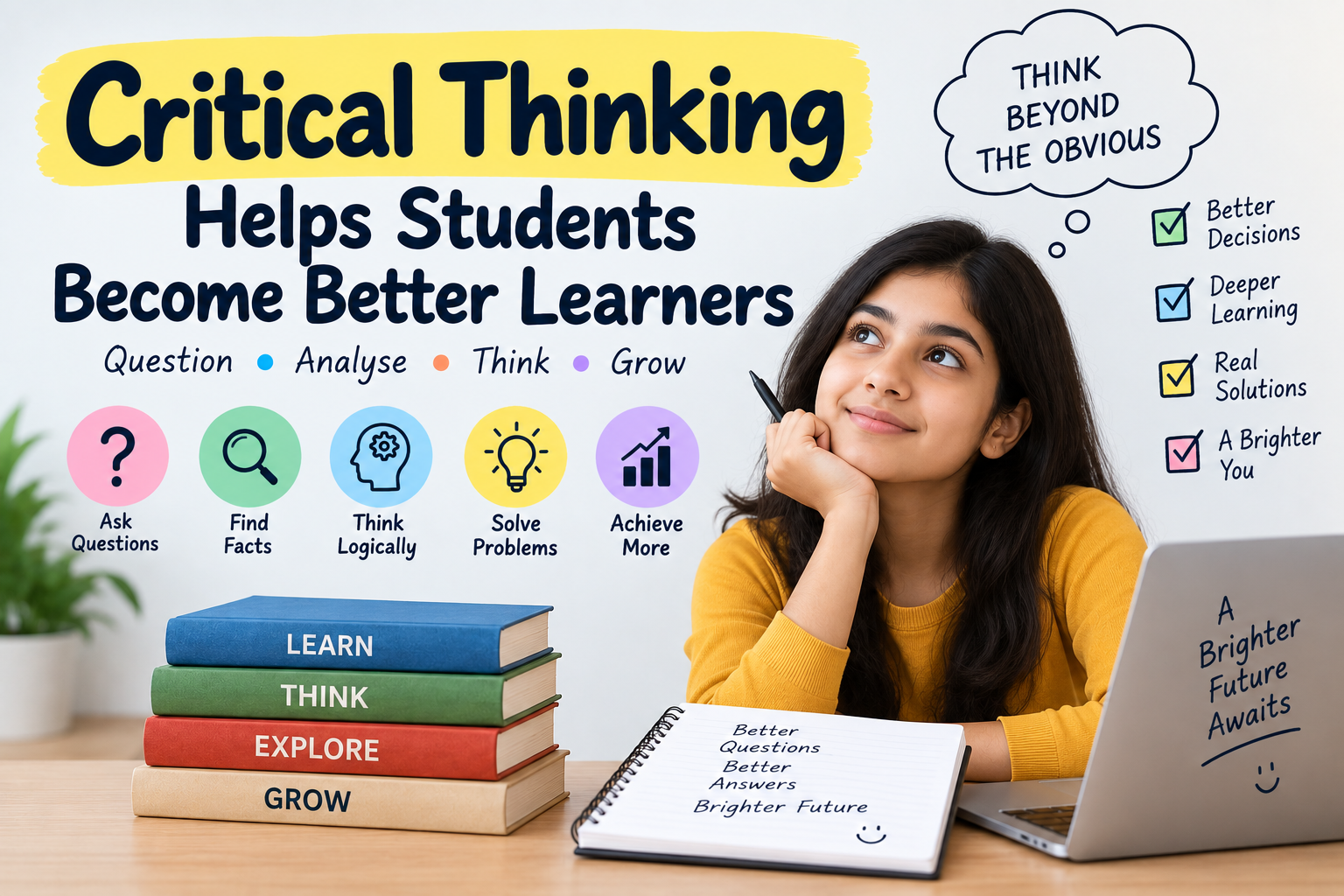
How Critical Thinking Helps Students Become Better Learners
Introduction
Education is often associated with collecting information, remembering important points, and preparing for examinations. These are useful parts of learning, but education has another important purpose: teaching students how to think. Knowing information is valuable, but being able to understand it, question it, compare different ideas, and use it to solve problems is equally important. This ability is commonly known as critical thinking.
Critical thinking can help students become more active and independent learners. Instead of accepting every piece of information immediately, students learn to examine it carefully. They can ask questions, look for evidence, consider different viewpoints, and make decisions based on what they understand.
In today's world, students have access to an enormous amount of information through books, websites, social media, videos, and digital platforms. Because information is so easily available, knowing how to evaluate it has become an important educational skill.
What Is Critical Thinking?
Critical thinking is the process of carefully examining information, ideas, or situations before reaching a conclusion. It involves questioning assumptions, looking at evidence, comparing possibilities, and using logical reasoning.
A critical thinker does not automatically reject information. Instead, they try to understand whether the information is supported by reliable evidence.
For example, if a student reads an interesting claim online, the student can ask where the information came from, whether the source is trustworthy, whether evidence has been provided, and whether other reliable sources support the same claim.
This approach can help students make more informed decisions.
Why Critical Thinking Matters in Education
Critical thinking is useful because education is not simply about remembering answers. Students regularly encounter questions that require interpretation and reasoning.
A mathematics problem may require choosing the correct method. A science question may require understanding why an experiment produced a particular result. A history topic may involve examining different sources and perspectives.
In each case, students need to think rather than simply repeat memorized information.
Critical thinking can therefore make learning deeper and more meaningful.
Critical Thinking Encourages Students to Ask Questions
Questions are an important part of learning.
A student who asks "Why does this happen?" or "How do we know this is true?" is actively trying to understand a topic.
Teachers can encourage this habit by welcoming genuine questions in the classroom.
Students should not feel embarrassed about asking questions simply because they think everyone else understands the topic. Sometimes one student's question can help an entire class understand an idea more clearly.
Asking questions is not a sign that a student knows less. It can be a sign that the student wants to understand more.
Moving Beyond Memorization
Memorization has a place in education. Students need to remember formulas, vocabulary, definitions, facts, and other basic information.
However, memorization alone may not be enough for more complicated problems.
Suppose a student remembers a scientific formula but does not understand when or why to use it. The student may struggle when the question is presented in an unfamiliar way.
Understanding the concept allows the student to apply the formula in different situations.
Critical thinking helps students move from simply knowing something to understanding how and why it works.
Critical Thinking and Problem-Solving
Problem-solving and critical thinking are closely connected.
When students face a difficult problem, they can first identify what is actually being asked. They can then collect relevant information, consider possible approaches, and examine the results.
This process can be used in academic subjects as well as everyday situations.
For example, if a group project is falling behind schedule, students can identify the reason, discuss possible solutions, decide what changes are needed, and review whether those changes are working.
The experience teaches students how to approach problems systematically.
Learning to Evaluate Information
The internet has made information easy to access, but not all information available online is equally reliable.
Students may encounter educational material, personal opinions, advertisements, outdated information, and misleading claims on the same platform.
Critical thinking helps students slow down before accepting information.
They can check the source, look for supporting evidence, consider the date, and compare the information with other reliable sources.
This is particularly important when students are preparing assignments or research projects.
Fact and Opinion
Students should learn to distinguish between facts and opinions.
A fact is a statement that can generally be checked against evidence. An opinion expresses a person's belief, preference, interpretation, or judgment.
Sometimes the difference can be difficult to identify because opinions may be presented in confident language.
Students can look for evidence and consider whether the statement can actually be verified.
Learning this distinction can improve both academic research and everyday media literacy.
The Role of Evidence
Evidence is an important part of critical thinking.
When someone makes a claim, students can ask what supports that claim.
For example, if a website says that a particular study method improves learning, a student can look for information about how the claim was established. Was there research? Who conducted it? How large was the study? Are there limitations?
Students do not need to become professional researchers to ask these basic questions.
Even simple checking can help them become more careful readers.
Critical Thinking in Different Subjects
Critical thinking is useful across almost every academic subject.
In science, students can examine evidence from experiments.
In mathematics, they can check whether a solution logically follows from the information given.
In history, they can compare different sources and understand that historical accounts may emphasize different details.
In literature, students can interpret characters, themes, and writing techniques.
In commerce, students can examine business information and consider different decisions.
The skill is therefore not limited to one particular field.
Critical Thinking and Classroom Discussions
Classroom discussions can provide excellent opportunities for students to practise critical thinking.
A teacher can introduce a question and allow students to explain their views. Students can listen to different opinions and respond with reasons rather than simply saying that they agree or disagree.
This process teaches students that people can have different interpretations of the same issue.
It also teaches an important communication skill: disagreeing respectfully.
A useful discussion is not necessarily one in which everyone reaches the same conclusion. The purpose can be to understand the reasoning behind different views.
The Importance of Listening
Critical thinking is not only about speaking.
Listening carefully is equally important.
When students listen to another person's explanation, they can identify the main argument and consider the evidence supporting it.
They may discover that the other person has a point they had not considered.
Good critical thinking therefore requires openness to new information.
Changing one's opinion after receiving convincing evidence is not a weakness. It can be a sign that the person is willing to learn.
Critical Thinking and Creativity
Critical thinking and creativity may appear to be different skills, but they can support each other.
Creativity involves generating new ideas, while critical thinking can help evaluate those ideas.
For example, a student may develop several possible solutions to an environmental problem. Critical thinking can then be used to consider which solutions are practical, affordable, safe, and effective.
Having many ideas is useful, but knowing how to evaluate them is also important.
Developing Independent Learners
Students who develop critical-thinking skills can become more independent learners.
Instead of waiting for someone to provide every answer, they can learn how to find information, ask appropriate questions, and check their understanding.
This becomes particularly important in higher education, where students are often expected to study independently.
It can also help after graduation because learning does not stop when formal education ends.
The Role of Teachers in Developing Critical Thinking
Teachers can encourage critical thinking by asking students questions that require explanations rather than simple yes-or-no answers.
Instead of asking only "What is the answer?", a teacher can ask "How did you reach that answer?" or "Why do you think this method works?"
Teachers can also use case studies, experiments, debates, problem-solving activities, and group discussions.
The aim is to create a classroom where students are encouraged to think and explain rather than simply memorize.
The Role of Students
Students also have responsibility for developing their thinking skills.
They can become more active during lessons by asking questions and taking notes in their own words.
When studying, they can try to explain a concept without looking at the textbook. If they cannot explain it, they know that they need to study it again.
Students can also compare different explanations of the same topic and think about which one is clearer and why.
These small habits can gradually improve independent thinking.
Critical Thinking and Online Content
Students spend a significant amount of time consuming digital content. Videos, posts, advertisements, articles, and comments can all influence what they think about a topic.
A critical thinker does not assume that something is true simply because it has many views or likes.
Popularity does not automatically prove accuracy.
Students can check the original source, look for evidence, and consider whether the content may be designed primarily to attract attention.
This does not mean that online content is always unreliable. It means students should evaluate it carefully.
The Influence of Headlines
Online headlines are often designed to attract attention.
A headline may sound surprising or dramatic, while the full article provides a much more complicated explanation.
Students should therefore avoid forming strong conclusions from a headline alone.
Reading the complete material and checking the source can provide better context.
This is a simple example of how critical thinking can improve digital literacy.
Avoiding Quick Conclusions
People sometimes make decisions before they have enough information.
Students can practise avoiding this habit by pausing and asking what they actually know.
If there are several possible explanations for a situation, they can consider each one before choosing a conclusion.
For example, if a student receives a low score on a test, it may be tempting to conclude that the subject is too difficult. But there could be several reasons, such as insufficient revision, misunderstanding a particular topic, careless mistakes, or difficulty managing time.
Looking at the situation carefully can lead to a more useful response.
Learning From Mistakes
Mistakes can provide useful information.
When students make an error, they can simply correct it and move on, or they can try to understand why the error happened.
The second approach can be more educational.
A student who understands the reason behind a mistake may be less likely to repeat it.
Teachers can support this by treating mistakes as opportunities for improvement rather than reasons for embarrassment.
Critical Thinking and Examinations
Critical thinking can also be useful during examinations.
Some examination questions require students to apply knowledge rather than reproduce a definition.
Students may need to compare ideas, explain reasons, interpret information, solve unfamiliar problems, or justify an answer.
Preparing only through memorization may not fully prepare them for such questions.
Practising different types of problems can help students become more comfortable with unfamiliar situations.
Critical Thinking and Career Preparation
Employers in many fields expect employees to deal with problems and make decisions.
A workplace may not always provide a step-by-step instruction for every situation.
Employees may need to examine information, identify a problem, communicate with colleagues, and choose an appropriate solution.
Students who practise these skills during their education can gain experience with this kind of thinking.
Critical thinking is therefore relevant not only to academic success but also to professional development.
How to Practise Critical Thinking Every Day
Students can develop critical thinking through simple daily habits.
When reading an article, they can ask what the main argument is. When watching an educational video, they can think about whether evidence has been provided. When solving a problem, they can explain why their chosen method works.
They can also discuss ideas with classmates and listen to different perspectives.
The purpose is not to question everything without reason. The purpose is to think carefully before accepting or rejecting an idea.
A Simple Five-Step Method
Students can use a simple five-step approach when they need to evaluate a problem or piece of information:
Step 1: Understand the question. Make sure you know what is actually being asked.
Step 2: Collect information. Find the facts and details that are relevant.
Step 3: Check the evidence. Consider whether the information comes from a reliable source.
Step 4: Compare possibilities. Look at different explanations or solutions.
Step 5: Reach a conclusion. Choose the conclusion that is best supported by the available information.
This method is simple enough to use in everyday study.
Critical Thinking Does Not Mean Negative Thinking
Sometimes people misunderstand critical thinking as constantly finding faults. That is not its purpose.
Critical thinking means examining information carefully. A student can agree with an idea after evaluating the evidence, just as they can disagree with it.
The important part is the reasoning behind the conclusion.
A critical thinker should be willing to consider information that challenges their existing beliefs.
Building a Habit of Thinking Carefully
Critical thinking improves with practice.
Students should not expect to become excellent critical thinkers after reading one article or completing one activity.
The skill develops gradually through repeated practice.
Every assignment, discussion, research project, and problem can provide an opportunity to think more carefully.
Over time, students may begin to notice that they automatically ask better questions and examine information more closely.
Conclusion
Critical thinking is an important part of modern education because students need more than the ability to remember information. They need to understand ideas, evaluate evidence, solve problems, ask meaningful questions, and make thoughtful decisions.
The large amount of information available through the internet makes these skills even more useful. Students can no longer depend only on finding information. They also need to determine whether the information is reliable and relevant.
Teachers can encourage critical thinking through discussions, projects, questions, experiments, and problem-solving activities. Students can develop the skill through small daily habits such as checking sources, comparing ideas, explaining their reasoning, and learning from mistakes.
Critical thinking does not mean doubting everything. It means being curious, careful, and willing to examine information before reaching a conclusion.
When students learn how to think as well as what to learn, education becomes more valuable. They become better prepared not only for examinations, but also for higher education, careers, and the many decisions they will face throughout life.