How Time Management Can Help Students Succeed in Their Studies
Introduction
Student life can be exciting, but it can also become stressful when there are too many things to complete at the same time. Classes, homework, assignments, examinations, projects, personal activities, family responsibilities, and sometimes part-time work can all take up a student's time. When students do not have a clear plan, they may feel that there are never enough hours in the day.Time itself is the same for everyone. Every student gets twenty-four hours in a day. The difference is often in how those hours are used. Time management does not mean studying all day without taking breaks. It means understanding what needs to be done, deciding what is important, and giving different activities an appropriate amount of time. A good time-management routine can help students complete their academic work while still leaving time for rest, hobbies, family, friends, and personal development. Developing this habit during school or college can also be useful later in professional life. Students who learn to organize their time may find it easier to handle responsibilities and deadlines in the future.
What Is Time Management?
Time management is the process of planning and organizing how available time will be used.For students, this can include deciding when to study, when to complete assignments, when to revise lessons, and when to take breaks. It can also involve setting priorities and avoiding activities that unnecessarily consume time.Good time management does not require an expensive planner or a complicated application. A simple notebook, calendar, or phone reminder can be enough.The most important part is not the tool. It is the habit of using a plan consistently.
Why Is Time Management Important for Students?
It Reduces Last-Minute Pressure.One of the most common problems students face is completing work just before the deadline.An assignment may be given several days in advance, but a student might keep postponing it. When the deadline approaches, the student has to complete everything quickly.This can create unnecessary pressure.Breaking a large task into smaller parts can make the work easier. A student can research on one day, prepare notes on another day, write the assignment later, and keep some time for checking it.
Instead of facing the entire task at once, the student deals with manageable steps.It Helps Students Stay Organized.A busy schedule can become confusing when students try to remember everything mentally.They may forget an assignment, miss an important date, or remember an examination only a few days before it happens.
Writing important tasks down can solve part of this problem.Students can maintain a weekly list containing classes, assignments, tests, projects, and other important activities. Once everything is visible, it becomes easier to decide what should be done first.It Creates Time for Revision. Learning a topic once is not always enough.Regular revision gives students an opportunity to review information and identify areas they have forgotten or misunderstood.
A student who plans study time throughout the week can revise gradually. This is often more manageable than trying to study an entire subject the night before an examination.Revision can be especially useful for subjects that contain formulas, definitions, concepts, dates, or technical procedures.
Setting Clear Goals
Time management becomes easier when students know what they are trying to achieve.Instead of making a general plan such as "I will study today," a student can create a more specific goal.
For example:
- Complete two chapters of mathematics.
- - Revise yesterday's science lesson.
- Write the introduction of an assignment.
- Practise ten programming problems.
- Read twenty pages of a textbook.
Specific goals make it easier to know when a task has been completed.
Students should also keep their goals realistic. Planning ten hours of study when they normally manage three or four hours may result in frustration. A practical plan is usually more useful than an ambitious plan that cannot be followed.
Understanding Priorities .
Not every task has the same level of importance.A project due tomorrow may need attention before an assignment due next week. Similarly, preparing for an examination that is approaching may be more urgent than reading additional material for a subject with no immediate deadline.
Students can divide tasks into categories such as:Important and urgent: Complete these first.Important but not urgent: Schedule these in advance.
Less important: Complete them after higher-priority work.This simple approach can help students decide where their attention should go.
Creating a Study Schedule
A study schedule does not need to be complicated.Students can start by identifying their fixed activities, such as school or college hours. They can then add study periods around those activities.
For example, a student may reserve one hour in the evening for revision and another hour for assignments. On weekends, additional time can be used for projects or subjects that require more attention.The schedule should also include breaks.Studying continuously for several hours can become tiring. Short breaks can give the mind an opportunity to rest before returning to the next task.
The Value of Short Study Sessions
Some students believe that they need to study for several hours at a time to make progress. That is not always necessary.Short, focused study sessions can be useful, especially when a student is trying to build a regular habit.
For example, a student can study for 30 to 45 minutes and then take a short break. During the study period, the student can focus on one specific task rather than trying to study several subjects simultaneously.The ideal study duration can differ from one person to another. Students should find a routine that they can maintain comfortably.
Avoiding Procrastination
Procrastination means delaying something that needs to be done.It is common among students. A student may decide to start an assignment later, watch a few videos first, or check social media for a few minutes. Sometimes those few minutes become much longer.One useful approach is to start with a very small step.Instead of thinking, "I have to finish this entire assignment," a student can say, "I will work on it for ten minutes."Starting is often the hardest part. Once the work has begun, continuing may feel easier.
Managing Mobile Phone Use
Mobile phones can be useful educational tools, but they can also become a major distraction.Students can use phones to watch educational videos, search for information, communicate with classmates, and access learning applications. At the same time, notifications, social media, games, and entertainment can interrupt concentration.During focused study sessions, students can reduce unnecessary notifications or keep the phone away from the study area.This does not mean that students must completely stop using their phones. The goal is to use technology intentionally instead of allowing it to control their attention.
Avoiding Multitasking
Students sometimes try to study while watching videos, chatting with friends, listening to unrelated content, and checking notifications.This can make concentration difficult.Doing one task at a time can make it easier to give full attention to the work.
For example, while solving mathematics problems, a student can keep the study material open and avoid switching repeatedly between different applications.Once the study session is finished, other activities can be given their own time.
Taking Proper Breaks
Breaks are not a waste of time.The brain needs rest, particularly after periods of concentrated work. A short break can involve walking around, drinking water, stretching, or simply sitting away from the study material.However, students should be careful about choosing activities that are difficult to stop. Opening social media "for five minutes" can sometimes turn into an hour.A planned break with a clear limit can be more useful.
Sleep and Student Performance
Time management also includes sleep.Some students sacrifice sleep to study late into the night, particularly before examinations. While this may provide additional study time, regularly ignoring sleep can make it harder to stay alert and concentrate the following day.Students should try to maintain a reasonably consistent sleep schedule.Good planning can reduce the need for frequent late-night study sessions.When students begin preparing earlier, they have less reason to depend on last-minute studying.
Making Time for Physical Activity
Students spend a large part of their day sitting in classrooms or studying.Physical activity can provide a useful break from academic work. Walking, cycling, sports, stretching, or other suitable activities can be included in a daily routine.The purpose is not necessarily to become an athlete. Even simple movement can provide a change from sitting and studying continuously.Students can choose activities that fit their interests and schedules.
Balancing Study and Personal Life
Education is important, but students also need time for their personal lives.Spending time with family, meeting friends, enjoying hobbies, reading for pleasure, listening to music, or participating in creative activities can provide a healthy break from academic responsibilities.A good schedule should not make students feel that every minute must be spent studying.Balance is important.When students have planned time for relaxation, they may find it easier to concentrate when it is time to study.
Using a To-Do List
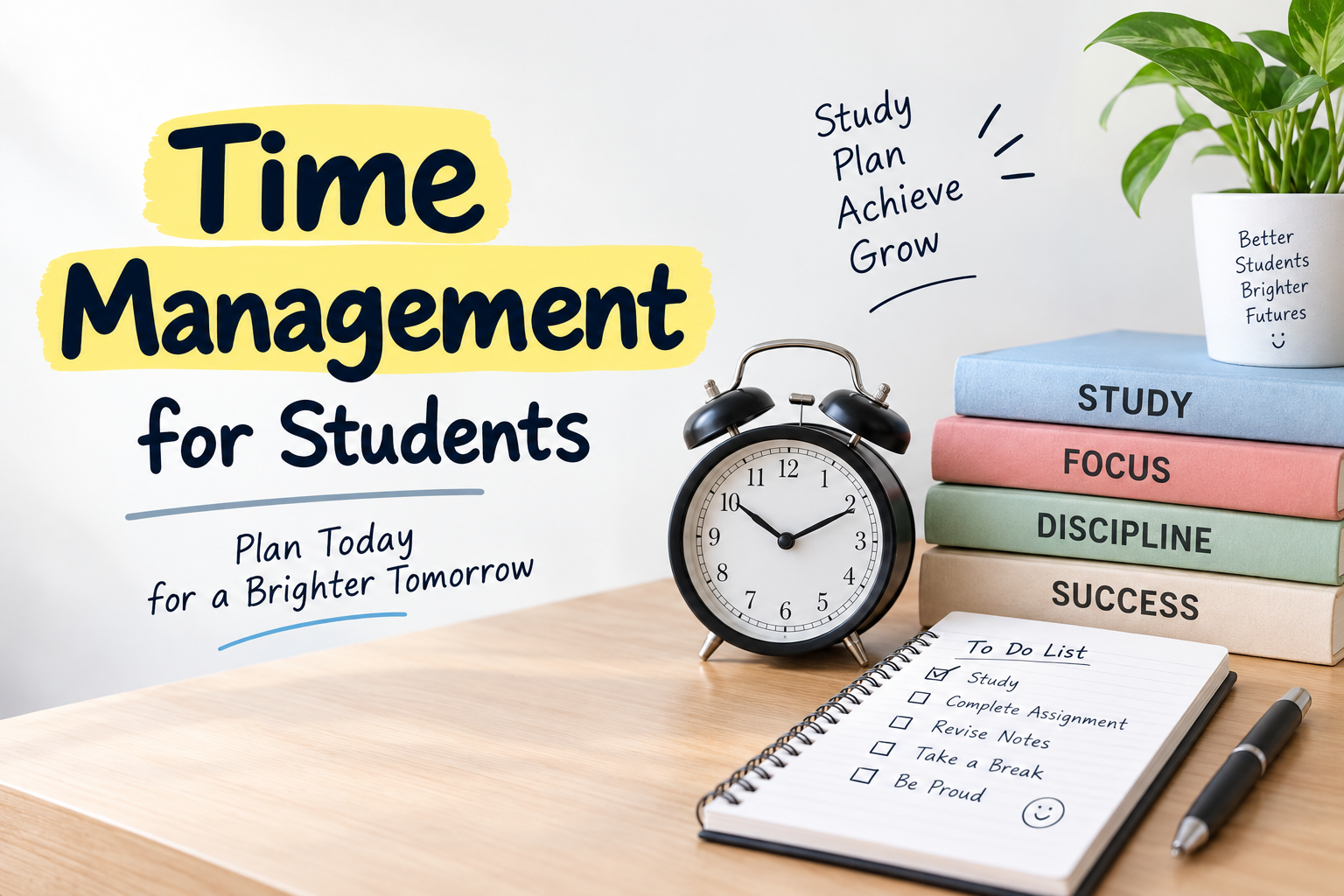
A simple to-do list can be surprisingly effective.At the beginning or end of the day, students can write down the tasks they need to complete.
For example:
1. Revise Chapter 3.
2. Complete mathematics homework.
3. Read research material for the project.
4. Prepare tomorrow's college notes.
5. Spend thirty minutes practising a skill.
As tasks are completed, students can mark them as finished.Seeing completed tasks can provide a sense of progress and make a busy day feel more manageable.
Planning for Examinations
Examination preparation should ideally begin before the final few days.Students can look at the syllabus and divide it into smaller sections. Each section can then be assigned to particular days.
For example, if a subject contains ten chapters and the student has twenty days available, the student can plan the chapters across the available time while keeping some days for revision and practice.This approach also leaves room for unexpected problems.If one topic takes longer than expected, there is still some flexibility in the schedule.
Learning to Say No
Students sometimes accept too many activities because they do not want to disappoint others.Participating in college events, clubs, competitions, and social activities can be valuable, but students should also consider their existing responsibilities.If the schedule is already full, taking on another major commitment may create unnecessary pressure.Learning to say "not now" can be an important part of managing time.It does not mean avoiding opportunities. It means choosing opportunities carefully.
Time Management for College Students
College students often have more freedom than school students.There may not always be someone reminding them to complete assignments or attend every activity.This freedom can be useful, but it also requires responsibility.College students can use calendars to record examination dates, assignment deadlines, project milestones, internships, and other commitments.They should also avoid assuming that there will always be enough time later.College work can become busy very quickly, particularly near examination periods.
Building the Habit Gradually
Students do not need to become perfect at time management immediately.A better approach is to make small changes.For example, during the first week, a student might simply start writing down daily tasks. The following week, they could introduce fixed study periods. Later, they could add weekly planning and examination schedules.
Small changes are easier to maintain.If a schedule does not work, it can be adjusted.A timetable should support the student rather than become another source of stress.
Common Time-Management MistakesThere are several mistakes students can avoid.One is creating an unrealistic timetable. If every minute is scheduled without any flexibility, even a small delay can disrupt the entire day.Another mistake is ignoring difficult subjects. Students sometimes spend more time on subjects they enjoy and postpone subjects they find challenging.A third mistake is failing to review the schedule. A plan should be changed when circumstances change.Students should also avoid comparing their study routine with someone else's. Different students have different responsibilities, learning speeds, and preferred study methods.
Learning to Adjust the Plan
No schedule works perfectly every day.A student may become sick, receive an unexpected assignment, attend an important family event, or discover that a particular topic requires more study time.This is normal.Instead of abandoning the entire plan, students can adjust it.
For example, if one task could not be completed today, it can be moved to another available time. The important thing is to understand why the delay happened and prevent it from becoming a repeated pattern.Flexibility is an important part of effective time management.
Time Management and Future CareersThe benefits of time management do not end after graduation.Most jobs involve deadlines, meetings, projects, responsibilities, and competing priorities.Employees need to decide which tasks require immediate attention and which can be scheduled for later.Students who practise these habits during their education may find the transition to professional responsibilities more familiar.Time management is therefore not just a study technique. It is a life skill.
A Simple Daily Routine for Students
Every student's schedule will be different, but a simple structure can be useful.The day can begin by identifying the most important tasks. After classes or college, students can take some time to rest before starting academic work.Study sessions can be divided between assignments, revision, and practice. Short breaks can be included between focused sessions.The evening can be used to review what was completed and prepare a short plan for the following day.The routine does not have to be followed perfectly. Its purpose is to provide direction.
Conclusion
Time management can make student life more organized and less stressful. It helps students understand their priorities, avoid unnecessary delays, prepare for examinations, complete assignments on time, and create space for personal activities.Good time management does not mean studying every hour of the day. It means using available time thoughtfully.Students can begin with simple habits such as making a daily to-do list, setting realistic goals, reducing distractions, taking proper breaks, and preparing for important deadlines in advance.
There will always be days when a plan does not work. That is part of normal life. What matters is the ability to review the situation, make changes, and continue.The earlier students develop the habit of managing their time, the more useful the skill can become. Education is not only about gaining knowledge from books. It is also about developing habits that can help students handle responsibilities throughout their lives.
Time cannot be saved for tomorrow, but it can be planned and used wisely today.