- Intention over Urgency: Choosing actions based on core values and long-term goals rather than constantly reacting to immediate fires, notifications, and external demands.
- Presence over Multi-tasking: Committing fully to one single task at a time, which reduces the cognitive friction caused by switching between different activities.
- Energy Management over Time Management: Recognizing that a highly focused hour is vastly more valuable than four hours of exhausted, distracted work.
- Compassion over Self-Criticism: Accepting that setbacks, distractions, and low-energy days are part of the human experience, and using those moments as data points rather than reasons for guilt.
- Ask yourself: If I could only get one thing done today before leaving, which task would make me feel the most fulfilled?
- Dedicate your peak energy hours to this single item.
- List no more than two secondary tasks. Anything else completed beyond these three items is a bonus.
Once you understand your internal rhythm, map your tasks accordingly:
- High-Energy Zones: Reserve for deep work, strategic thinking, and complex problem-solving.
- Low-Energy Zones: Allocate to administrative chores, clearing inbox backlogs, organizing files, or returning low-stakes phone calls.
+-------------------+-----------------------------+-----------------------------+

| Energy Level      | Typical Time Window         | Ideal Task Allocation       |
+-------------------+-----------------------------+-----------------------------+

| High (Peak)       | 08:30 AM - 11:30 AM         | Deep work, writing, strategy|
+-------------------+-----------------------------+-----------------------------+

| Low (Trough)      | 01:30 PM - 03:30 PM         | Inboxes, filing, admin tasks|
+-------------------+-----------------------------+-----------------------------+

| Medium (Rebound)  | 03:30 PM - 05:30 PM         | Collaborative meetings, tidy|
+-------------------+-----------------------------+-----------------------------+
- Aggressive Notification Filtering: Turn off all non-human notifications. If a machine is buzzing to tell you an app updated or a social media post was liked, it is stealing your attention.
- Batching Communication: Instead of keeping your email client open all day, check it at three designated times: mid-morning, after lunch, and before wrapping up for the day.
- Digital De-cluttering: Treat your digital workspace like a physical desk. Keep your desktop clean, close unused browser tabs, and use full-screen modes to eliminate visual distractions while working.
- The Transition: Before starting the 25-minute timer, close your eyes and take three deep breaths to anchor your mind to the task.
- The Work Interval: Work with absolute dedication. If an unrelated thought pops up, write it down on a "distraction pad" to clear it from your working memory, then return gently to the task.
- The Mindful Break: During the 5-minute break, avoid scrolling on your phone or reading the news. Step away from your screen, stretch, drink water, or look out a window. This allows your brain's default mode network to rest and process information.
- Ask yourself: What emotion am I avoiding right now?
- If the emotion is fear of failure, break the task down into an absurdly small, non-threatening step (e.g., "Open a blank document and write one sentence").
- If the emotion is overwhelmed by scope, remind yourself that you do not need to finish the project today; you only need to work on it mindfully for twenty minutes.
- Review what you accomplished.
- Update your task list for the following day so your mind doesn't try to remember it overnight.
- Physically close your laptop, clean up your desk space, and take a conscious breath to mark the transition from your professional role to your personal life.
- What did I accomplish this week that aligned closely with my core intentions?
- Where did I lose my focus or feel my energy drain unnecessarily?
- How can I adjust my environment, schedule, or expectations next week to support better mental balance?
- What industry or type of work do you do?
- What is your biggest daily distraction (e.g., meetings, chat apps, procrastination)?
- What does your current planning system look like?
We live in a world obsessed with doing more. More hours. More busy. More output. Productivity advice tends to focus on squeezing every last drop of time and efficiency out of the day and optimising everything up the wazoo, as if gapless calendar is badge of honour.
But what if productivity wasn’t just about doing more, but about doing what actually matters? In a way that’s intentional, sustainable, and aligned with how you work best.
That’s where mindful productivity comes in.
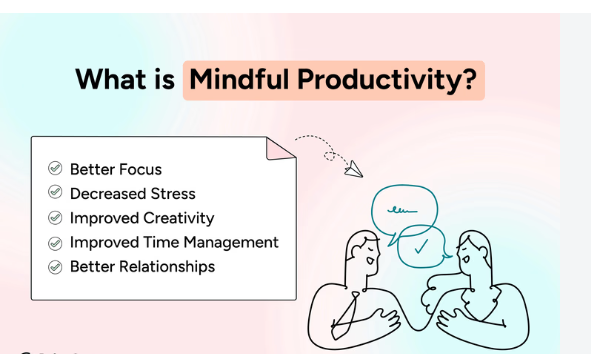
What Is Mindful Productivity?
Many definitions of mindful productivity focus on productivity grounded in presence, balance and sustainability. All crucial elements. But they often miss something deeper.
Mindfulness, at its core, isn’t just about self-awareness. It’s also about interconnection, compassion and intentional impact. It’s about recognising that how we work doesn’t just affect us, it affects the people around us, our communities and the systems we operate within.
Without these elements, mindful productivity risks becoming just another individualistic pursuit of better self-optimisation. When in reality, it’s about working in a way that supports both personal and collective wellbeing.
Mindful Productivity: A Deeper Definition
Mindful productivity is the practice of sustainable, intentional and meaningful action informed by conscious awareness and acceptance of your unique mental, emotional and physical state, innate nature and needs — within the context of our interconnected human experience. It empowers you to engage in focused flow, supporting both personal and collective care, wellbeing and impact.
After burning out a few times in my life as a creator and entrepreneur, I had to learn some important lessons and tools to make all this sustainable.
I love creating, working on my business, sharing my ideas, and helping people - it brings me a lot of meaning and fulfills me.
But this striving for more growth and to keep up with social media algorithms plus the disconnection from my body in the past led me to experience more pressure than was healthy for my mind and body.
As a creator, it's hard to draw the line between what's "living" and what's "creating and working".
It all sort of blends together, because it's all fun and games most times - which was my intention from the start back in 2011 - to not live a 9-5, where life and work is clearly separated. All this also came with its challenges.
I eventually realized that my capacity to create and help others is directly linked to my mental, emotional, and physical health. It is all one.
In order to not only stay healthy but wealthy in a holistic manner, I had to:
-
question conventional ideas of productivity and success.
-
apply mindfulness + awareness to all areas of life.
Enter mindful productivity.
In its simplest terms, I define it as the combination of mindfulness and productivity.
This means bringing a more present and conscious quality to creating and working while being closely tuned into my emotions, mental state and physical sensations - and taking actions to strengthen this connection, be more self-compassionate, and managing my nervous system responses.
Today, I experience more mental clarity, more flow, more energy. My body and mind are healthier and happier. I feel more connected to my purpose.