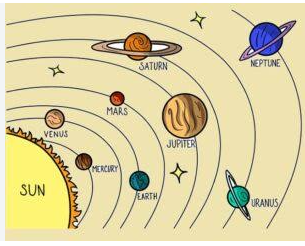
Our solar system is a vast, gravitationally bound framework born roughly 4.6 billion years ago from the collapse of a giant interstellar molecular cloud. Located in the Orion Cygnus arm of the Milky Way galaxy, our cosmic neighborhood consists of a central star—the Sun—and every celestial object captured by its immense gravitational pull. This includes eight major planets, dozens of dwarf planets, hundreds of moons, and millions of smaller bodies like asteroids, comets, and meteoroids. Understanding the structure, dynamics, and composition of the solar system provides vital context for how our own planet formed and whether life exists beyond Earth.
The Heart of the System: The Sun
At the center of our solar system sits the Sun, a nearly perfect sphere of hot plasma that accounts for 99.86% of the system's total mass. It is classified as a yellow dwarf star (G2V) and serves as the primary engine driving the climate, weather, and life cycles of the surrounding planets.
The Sun’s immense gravity keeps the planets, asteroids, and comets locked in their respective orbits. Deep within its core, temperatures exceed 15 million degrees Celsius, creating conditions extreme enough to sustain nuclear fusion. Through this process, hydrogen atoms fuse to form helium, releasing a tremendous amount of energy that radiates outward as light and heat.
Beyond its light, the Sun continuously ejects a stream of charged particles known as the solar wind. This wind creates a vast bubble called the heliosphere, which extends far past the outer planets, shielding the solar system from harsh interstellar cosmic rays.
The Inner Solar System: Terrestrial Planets
The four planets closest to the Sun are known as the terrestrial planets: Mercury, Venus, Earth, and Mars. These worlds are characterized by their solid, rocky surfaces, high densities, and a lack of extensive ring systems.
Mercury
Mercury is the smallest and closest planet to the Sun. Because it lacks a substantial atmosphere to trap heat, it experiences the most extreme temperature fluctuations in the solar system, ranging from 430°C during the day to -180°C at night. Its surface is heavily cratered, closely resembling Earth's Moon, and it possesses a surprisingly large iron core that generates a weak magnetic field.
Venus
Venus is often called Earth’s twin due to its similar size, mass, and composition. However, their environments are drastically different. Venus is blanketed by a thick, toxic atmosphere rich in carbon dioxide, with clouds of sulfuric acid. This creates a runaway greenhouse effect, making it the hottest planet in the solar system with a constant surface temperature of around 465°C—hot enough to melt lead.
Earth
Earth is the only known planet to harbor life. It is unique because of its abundant liquid water, which covers over 70% of its surface, and an atmosphere rich in nitrogen and oxygen. Earth's active geology, including plate tectonics, helps regulate its climate, while its robust magnetic field shields the surface from harmful solar and cosmic radiation.
Mars
Mars, known as the Red Planet, gets its distinct color from iron oxide (rust) covering its surface. It is a cold, desert world with a thin carbon dioxide atmosphere. Mars features giant extinct volcanoes, like Olympus Mons (the largest volcano in the solar system), and vast canyon systems. Visual and chemical evidence strongly suggests that liquid water once flowed across its surface billions of years ago.
The Outer Solar System: Jovian Planets
Beyond the inner solar system lies a region dominated by four massive planets known as the Jovian planets, or gas and ice giants. These worlds are composed primarily of hydrogen, helium, water, ammonia, and methane, and they possess extensive moon systems and prominent rings.
Jupiter
Jupiter is the largest planet in our solar system, with a mass more than twice that of all the other planets combined. It is a gas giant primarily made of hydrogen and helium. Jupiter is famous for its colorful bands of clouds and the Great Red Spot—a massive, counter-clockwise spinning storm wider than Earth that has raged for centuries. It acts as a cosmic shield for the inner planets, using its massive gravity to redirect inbound comets and asteroids.
Saturn
Saturn is best known for its spectacular and complex ring system, which consists of billions of particles of ice, rock, and dust ranging in size from tiny grains to massive boulders. Like Jupiter, Saturn is a gas giant with a low density; in fact, its average density is lower than that of water. Saturn hosts a diverse array of moons, including Titan, which features a thick atmosphere and liquid methane lakes.
Uranus
Uranus is classified as an ice giant because its interior contains a higher proportion of heavier elements like water, ammonia, and methane ice compared to hydrogen and helium. It has a distinct cyan hue caused by methane gas in its atmosphere. Uranus is unique for its extreme axial tilt of 98 degrees, meaning it effectively rolls on its side as it orbits the Sun, likely the result of a cataclysmic collision early in its history.
Neptune
Neptune is the most distant major planet from the Sun and the second ice giant. It is a dark, cold world swept by supersonic winds that can reach speeds of up to 2,100 kilometers per hour—the fastest recorded in the solar system. Neptune's deep blue color is also a result of atmospheric methane, and it possesses a highly active weather system, including short-lived giant storms.
Planetary Comparison Overview
The structural differences between the inner and outer planets highlight the distinct zones created during the solar system's formation.
| Planet | Average Distance from Sun (AU)* | Equatorial Diameter (km) | Moons | Notable Feature |
|---|---|---|---|---|
| Mercury | 0.39 | 4,879 | 0 | Shortest orbital period (88 Earth days) |
| Venus | 0.72 | 12,104 | 0 | Hottest surface temperature |
| Earth | 1.00 | 12,756 | 1 | Only world confirmed to host life |
| Mars | 1.52 | 6,792 | 2 | Home to Olympus Mons |
| Jupiter | 5.20 | 142,984 | 95+ | Largest planet and strongest magnetic field |
| Saturn | 9.58 | 120,536 | 140+ | Most extensive ring system |
| Uranus | 19.22 | 51,118 | 28+ | Rotates on a completely horizontal axis |
| Neptune | 30.05 | 49,528 | 16+ | Strongest planetary winds |
*Note: 1 AU (Astronomical Unit) is the average distance from Earth to the Sun, roughly 150 million kilometers.
The Realm of Small Bodies
The solar system is crowded with millions of smaller objects left over from the planetary construction era. These objects are grouped into distinct regions based on their composition and orbits.
- The Asteroid Belt: Located in the vast gap between Mars and Jupiter, this region contains millions of rocky and metallic bodies. Despite their numbers, the total mass of the Asteroid Belt is less than that of Earth's Moon. It contains the dwarf planet Ceres.
- The Kuiper Belt: Extending beyond Neptune's orbit, this freezing ring of icy bodies is home to Pluto, Eris, Haumea, and Makemake. The Kuiper Belt provides a glimpse into the pristine materials that formed the outer solar system.
- The Oort Cloud: This is a theoretical, immense spherical shell enveloping the entire solar system. It is believed to extend from outside the Kuiper Belt to nearly halfway to the next star system. The Oort Cloud contains trillions of icy objects and is the birthplace of long-period comets.
Key Natural Satellites (Moons)
While the solar system hosts hundreds of moons, several stand out for their complex geology and potential to harbor environments suitable for life.
- Ganymede (Jupiter): The largest moon in the solar system, it is even bigger than the planet Mercury. It is the only moon known to possess its own internally generated magnetic field.
- Titan (Saturn): The second-largest moon, Titan is the only satellite in the solar system with a dense atmosphere. It features clouds, rain, and stable surface lakes made of liquid hydrocarbons like methane and ethane.
- Europa (Jupiter) & Enceladus (Saturn): Both of these icy moons harbor vast, liquid water oceans beneath their frozen crusts. Enceladus regularly shoots massive plumes of water vapor and organic molecules into space from fractures at its south pole, making it a prime target in the search for extraterrestrial life.
- Io (Jupiter): Caught in a gravitational tug-of-war between Jupiter and neighboring moons, Io is the most volcanically active body in the solar system, featuring hundreds of active volcanoes erupting lakes of molten sulfur.
Boundaries and Interstellar Space
The solar system does not end abruptly. The boundary where the solar wind can no longer hold back the pressure of interstellar gas is called the heliopause. Voyager 1 and Voyager 2 crossed this threshold in 2012 and 2018, respectively, becoming the first human-made objects to enter interstellar space. Beyond the heliopause, the Sun's gravitational influence still dominates out to the edge of the Oort Cloud, marks the final frontier of our cosmic home
Inner Rocky Planets
- Mercury: The smallest planet and the closest to the Sun.
- Venus: The second planet from the Sun, known for a thick, hot atmosphere.
- Earth: The third planet from the Sun and our home.
Outer Giant Planets
- Jupiter: The fifth planet from the Sun and the largest planet in our solar system.
- Saturn: The sixth planet from the Sun, famous for its large ring system.
- Uranus: The seventh planet from the Sun, classified as an ice giant.
(Note: Pluto was once the ninth planet, but experts reclassified it as a dwarf planet in 2006. You can read more about them on the NASA Solar System Exploration page.) [1, 2]
Would you like to know more about a specific planet's moons, its size, or how long a year lasts on it?
The 8 Official Planets (In Order from the Sun)
- Mercury: The smallest planet and the closest to the Sun.
- Venus: The hottest planet with a thick, toxic atmosphere.
- Earth: Our home planet and the only one known to support life.
- Mars: The red planet, known for giant volcanoes and dry riverbeds.
- Jupiter: The largest planet in our solar system.
- Saturn: Famous for its large, beautiful rings made of ice and dust.
- Uranus
: An ice giant that spins completely on its side.
- Neptune: The farthest official planet, known for deep blue winds.
Space +3
What Happened to the 9th Planet (Pluto)?
- Pluto was long considered the ninth planet.
- In 2006, the International Astronomical Union reclassified Pluto as a dwarf planet because it does not clear its neighboring orbital zone.
Britannica
- You can read more about official definitions on NASA Science. Some people can you name all the planets? still fondly remember or include Pluto as the ninth
-
Key Facts About These Planets
- Exoplanets: Planets that exist outside our own solar system.
- Types found: Small rocky worlds, gas giants larger than Jupiter, super-Earths, and mini-Neptunes.
- Total estimate: Scientists believe hundreds of billions of planets exist in our Milky Way galaxy alone.
- Milestone: NASA passed the 5,000 mark in March 2022 and continues to add new discoveries through the NASA Exoplanet
-
Mars is the second smallest planet in our solar system.Planet Size Details
- Smallest Planet: Mercury is the smallest planet in the solar system.
- Second Smallest: Mars is next, with a radius of about 2,106 miles.
Archive.- Comparison:
Mars is about half the size of Earth.
-
Mars is the second smallest planet in our solar system.Planet Size Details
- Smallest Planet: Mercury is the smallest planet in the solar system.
- Second Smallest: Mars is next, with a radius of about 2,106 miles.
- Comparison:
Mars is about half the size of Earth.
-
Mars is the second smallest planet in our solar system.Planet Size Details
- Smallest Planet: Mercury is the smallest planet in the solar system.
- Second Smallest: Mars is next, with a radius of about 2,106 miles.
- Comparison:
Mars is about half the size of Earth.
-
Mars is the second smallest planet in our solar system.Planet Size Details
- Smallest Planet: Mercury is the smallest planet in the solar system.
- Second Smallest: Mars is next, with a radius of about 2,106 miles.
- Comparison:
Mars is about half the size of Earth.