The Impact of Mobile Phones on Students
Introduction
Mobile phones have become one of the most common and influential technologies in modern society. What was once mainly a device for making calls and sending messages has developed into a powerful tool for communication, education, entertainment, research, and social interaction. For students, mobile phones can be especially useful because they provide access to information almost instantly. A student can search for the meaning of a difficult word, watch an educational video, attend an online class, use a calculator, read an electronic book, or communicate with classmates within seconds.
However, the increasing use of mobile phones among students has also created concerns. Although smartphones can support learning, excessive or inappropriate use can distract students from their studies, interfere with sleep, reduce physical activity, and affect face-to-face communication. Research reviewed by UNESCO has found that smartphone use during learning can create distractions and that intensive technology use can negatively affect student performance.
Therefore, the impact of mobile phones on students is neither completely positive nor completely negative. Much depends on how, when, and why students use them. When used responsibly, mobile phones can be valuable educational tools. When used without limits, they can become a major source of distraction. Understanding both sides is important for students, parents, teachers, and schools.
Mobile Phones as Educational Tools
One of the greatest advantages of mobile phones is their ability to provide students with quick access to educational information. In the past, students often had to depend on textbooks, libraries, teachers, or other printed resources to find information. Today, a smartphone can provide access to digital books, educational websites, dictionaries, scientific information, videos, and learning applications.
Students can use mobile phones to revise lessons and improve their understanding of difficult subjects. For example, a student who finds a mathematical concept difficult can watch an explanation or use an educational application to practise questions. Similarly, students learning languages can use dictionaries and language-learning tools to improve their vocabulary and pronunciation.
Mobile phones can also support online learning. Students can attend virtual classes, download study materials, communicate with teachers, and submit assignments through digital platforms. This became particularly important when schools and colleges had to rely more heavily on online education.
Another advantage is portability. A mobile phone is much smaller and easier to carry than a collection of books and other educational materials. Students can revise notes while travelling or use free time productively. Educational content can also be updated quickly, allowing learners to access newer information.
UNESCO's research emphasizes that technology can support education when it is used appropriately and when it clearly contributes to learning. The important point is not simply whether technology is present, but whether it is being used for a meaningful educational purpose.
Better Communication
Mobile phones have made communication between students, teachers, parents, and classmates much easier. Students can quickly inform their parents about changes in schedules, ask classmates about homework, or communicate with teachers when appropriate.
Group messaging can also help students work together on projects. They can exchange ideas, share notes, discuss assignments, and remind each other about important deadlines. This can make collaboration more convenient.
Mobile phones can also help students remain connected with family members, especially when they travel to school or college. Parents can contact their children when necessary, which can provide a practical communication link.
However, communication through phones should not completely replace direct communication. Face-to-face conversations help students develop social skills, confidence, listening abilities, and emotional understanding. Therefore, mobile phones should be considered a tool for communication rather than a replacement for real-world relationships.
Mobile Phones and Academic Performance
The relationship between mobile phone use and academic performance depends greatly on the type and amount of use. Using a smartphone to research a topic or complete an educational activity can support learning. On the other hand, using the same device for unrelated entertainment during study time can interrupt concentration.
Notifications are one important source of distraction. A message, social-media notification, game alert, or video recommendation can immediately draw a student's attention away from a lesson or assignment. UNESCO reports that even the presence of a mobile device or incoming notifications can distract students from the task they are performing.
Multitasking can also create problems. Students may believe that they can study while simultaneously checking messages or watching short videos. However, repeatedly switching attention between activities can make it harder to remain focused on academic work.
The problem becomes greater when phone use replaces study time. A student may plan to spend ten minutes checking a phone but continue using it for much longer. As a result, homework may be delayed, revision may become rushed, and preparation for examinations may suffer.
This does not mean that every student who uses a smartphone will experience poor academic results. Instead, it shows why purposeful use is important. A phone can either support learning or compete with learning depending on how it is used.
Social Media and Students
Social media is one of the most popular uses of smartphones among young people. It allows students to communicate, share interests, discover information, and stay connected with friends. It can also provide educational communities and opportunities for creativity.
At the same time, social media can become highly distracting. Students may repeatedly check updates, comments, messages, or short videos instead of concentrating on schoolwork. The desire to remain constantly connected can make it difficult to put the phone aside.
The World Health Organization's European office reported in 2024 that problematic social-media use among adolescents had increased in the countries and regions covered by its survey, from 7% in 2018 to 11% in 2022. The report also noted an association between problematic social-media use, less sleep, and later bedtimes.
Social media can also expose students to cyberbullying and unhealthy online interactions. Therefore, students need digital literacy skills. They should learn how to communicate respectfully online, protect personal information, recognize unreliable information, and seek help from trusted adults when an online situation becomes uncomfortable or unsafe.
Effects on Sleep
Sleep is essential for learning, memory, concentration, and overall well-being. One concern associated with excessive smartphone use is that students may use their phones late at night instead of sleeping.
A student may intend to check one message before bed but then continue watching videos, chatting, or browsing. This can delay bedtime. Bright screens and stimulating content may also make it harder for some students to settle down for sleep.
Research involving medical students in Kerala found a significant association between higher smartphone screen time and poorer sleep quality. The study involved 370 MBBS students and reported that nearly half of the participants had poor sleep quality. Because it was a cross-sectional study, it shows an association rather than proving that smartphone use alone caused poor sleep.
Poor sleep can make students tired during classes and may reduce their ability to concentrate. Therefore, managing phone use in the evening is an important part of maintaining healthy study habits.
Physical Health and Lifestyle
Excessive mobile phone use can also affect students' daily routines. When students spend many hours sitting and looking at screens, they may have less time for exercise, outdoor activities, hobbies, and other healthy activities.
Long periods of screen use can also contribute to discomfort such as eye strain or poor posture. Students who hold their phones for extended periods may develop neck or hand discomfort.
The solution is not necessarily to stop using mobile phones completely. Instead, students should maintain balance. Regular movement, outdoor activity, proper posture, breaks from screens, and sufficient sleep are important parts of a healthy routine.
A balanced lifestyle allows technology to remain useful without allowing it to dominate the student's entire day.
Effects on Attention and Concentration
Concentration is one of the most important skills for academic success. Students need sustained attention when reading textbooks, solving problems, listening to lectures, writing assignments, and preparing for examinations.
Mobile phones can interfere with this concentration when they are used unnecessarily during study sessions. Even when a student does not respond to a notification, the expectation of receiving one may draw attention away from the task.
UNESCO's Global Education Monitoring research reviewed evidence from multiple countries and found that excessive or inappropriate technology use can interfere with learning. It also reported that a meta-analysis covering students from pre-primary through higher education found a small negative effect of mobile-phone use on educational outcomes, with distraction and non-academic activities being important factors.
This suggests that students should create periods of focused study during which unnecessary phone use is avoided.
Mobile Phones and Classroom Learning
The use of mobile phones inside classrooms is an important issue. A phone can be useful when a teacher specifically asks students to use it for research, educational applications, calculations, or other learning activities. However, unrestricted use can make classroom management more difficult.
Students may use phones for unrelated websites, games, social media, or entertainment instead of participating in the lesson. This can affect not only the individual student but also classmates who are distracted by the activity.
UNESCO reported in 2025 that, by the end of 2024, 79 education systems, representing about 40% of those monitored, had policies or laws banning smartphones in schools. By March 2026, UNESCO's monitoring reported that 114 education systems had national bans, representing 58% of countries worldwide. These figures demonstrate the growing global policy discussion around classroom phone use, although approaches differ between education systems.
The central question is therefore how schools can protect learning time while also teaching students responsible digital habits.
Impact on Family and Social Relationships
Mobile phones can strengthen relationships by making communication easier, but excessive use can also reduce direct interaction. A student who spends most free time looking at a screen may participate less in conversations with parents, siblings, teachers, or friends.
Family meals, outdoor activities, and conversations are opportunities for students to develop social and emotional skills. Constant phone use during these activities can reduce the quality of those interactions.
Students should therefore learn to recognize situations where putting the phone away is more appropriate. Being present during important conversations and spending time with family and friends without screens can contribute to healthier relationships.
Privacy and Online Safety
Another important issue is privacy. Students often share photographs, personal information, locations, opinions, and other details online without fully considering who may see them.
Educational and social applications can also collect information about users. UNESCO has highlighted concerns about privacy and children's data in educational technology.
Students should understand that information shared online may not always remain private. They should use strong passwords, avoid sharing sensitive personal information, think carefully before posting, and tell a trusted adult if they encounter threatening, inappropriate, or unsafe online behaviour.
Digital responsibility is now an important part of being a responsible student.
How Students Can Use Mobile Phones Responsibly
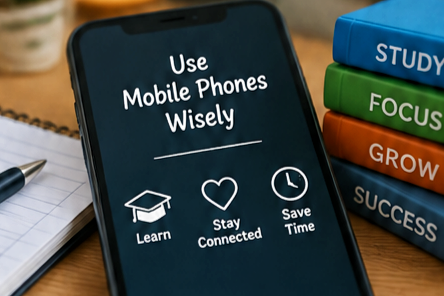
Responsible phone use begins with clear priorities. Students should decide when the phone is necessary and when it is simply a distraction.
First, students can create specific study periods during which unnecessary notifications are turned off. Second, they can keep social-media and entertainment applications away from study sessions. Third, they can avoid using phones immediately before sleeping and give themselves sufficient time to rest.
Students can also use their phones positively by downloading educational resources, taking digital notes, using calendars for time management, setting reminders, and accessing reliable information.
Teachers and parents can support students by explaining both the benefits and risks of technology rather than simply treating phones as either completely good or completely bad. Students need opportunities to develop self-control and digital literacy.
The Role of Parents and Teachers
Parents and teachers have an important role in helping students develop healthy technology habits. Instead of only imposing restrictions, adults can explain why responsible use matters.
Parents can establish reasonable family routines around study, sleep, meals, and recreational screen use. Teachers can provide clear rules for when phones may be used in classrooms and when they should remain put away.
Schools can also teach digital citizenship. Students should learn about privacy, online communication, misinformation, cyberbullying, distraction, and responsible use of digital tools.
The goal should be to prepare students for a world in which technology will continue to play an important role.
Conclusion
Mobile phones have changed the way students learn, communicate, and spend their free time. They provide many valuable opportunities, including quick access to information, educational resources, online learning, communication, collaboration, and organization. When used with a clear purpose, a smartphone can be an effective learning tool.
However, excessive and inappropriate use can create problems. Distractions, social-media overuse, reduced concentration, delayed sleep, reduced physical activity, and weaker face-to-face interaction are important concerns. Research and international education monitoring show that intensive or poorly managed technology use can interfere with learning.
The answer is not simply to label mobile phones as good or bad. Their impact depends largely on how they are used. Students need to learn when technology is helpful and when it should be put aside. Schools and families can support this by establishing sensible boundaries and teaching digital responsibility.