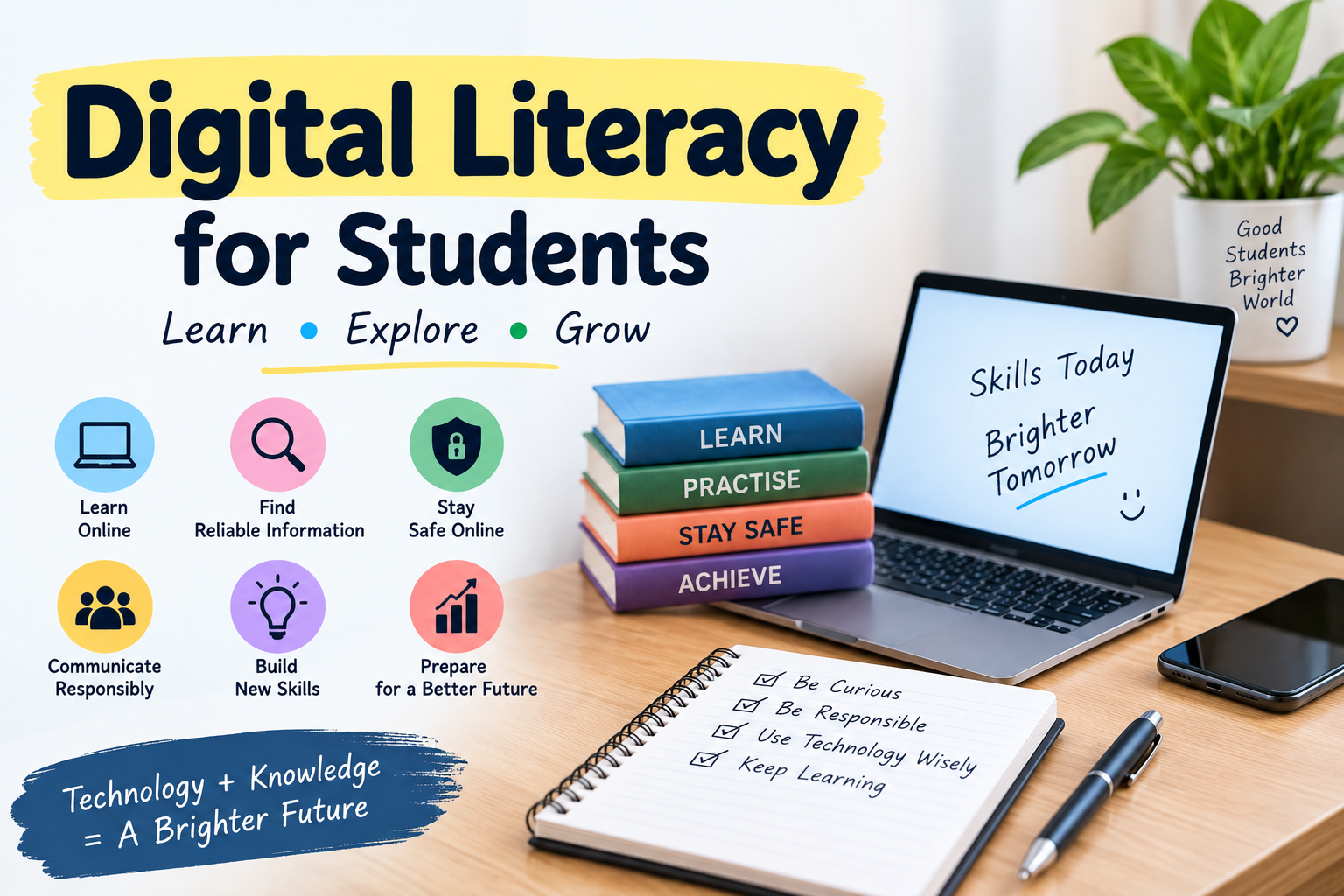
The Importance of Digital Literacy for Students in Modern Education
Introduction
Technology has become a normal part of everyday life. Students use smartphones, computers, tablets, online learning platforms, digital libraries, and many other tools for education and communication. Because of this change, knowing how to use digital technology responsibly has become an important part of modern education.
Digital literacy is not simply knowing how to operate a computer or use a mobile phone. It also means understanding how to search for information, identify reliable sources, protect personal information, communicate responsibly, and use digital tools for learning and creative work. Students who develop these abilities can make better use of technology in their education and future careers.
What Is Digital Literacy?
Digital literacy refers to the ability to use digital devices, applications, online services, and information effectively and responsibly. It includes both technical skills and the ability to think carefully about digital information.
For example, a digitally literate student should be able to search for information online, understand whether a website is trustworthy, create a document, send an appropriate email, use online learning resources, and protect an account with a strong password.
Digital literacy is therefore much broader than simply knowing how to use a smartphone.
Why Digital Literacy Matters for Students
It Makes Learning More Accessible
The internet has changed the way students access educational information. In the past, students often depended mainly on textbooks and physical libraries. Today, they can access digital books, research papers, educational videos, online courses, tutorials, and other resources.
This can be especially useful when a student wants to understand a topic from a different perspective. If a textbook explanation is difficult to understand, a student may find an educational video or interactive lesson that explains the same concept differently.
However, having access to information does not automatically mean that the information is correct. Students need to learn how to evaluate what they find.
It Helps Students Research Effectively
Research is an important part of education. Students often need to collect information for assignments, projects, presentations, and examinations.
Search engines make this process faster, but students should not simply select the first result and assume that it is accurate. They should consider who published the information, when it was published, whether evidence is provided, and whether the same information appears in reliable sources.
Learning how to search using suitable keywords can also save time. A specific search can often produce more useful results than a very general one.
Learning to Identify Reliable Information
One of the biggest challenges of the digital age is the huge amount of information available online.
Students may encounter genuine educational material alongside advertisements, opinions, outdated information, misleading posts, and false claims.
A useful habit is to check the source before accepting information as a fact. Students can look at the author's qualifications when relevant, the organization behind a website, the date of publication, and references or supporting evidence.
They can also compare important information with multiple trustworthy sources.
This skill is particularly important because online information can spread very quickly.
Digital Literacy and Online Safety
Students should also understand basic online safety.
Personal information such as passwords, financial details, identification documents, and private photographs should be handled carefully. Students should avoid sharing sensitive information with unknown people or untrusted websites.
Strong, unique passwords can provide better account protection. Where available, additional security methods such as two-step verification can provide another layer of protection.
Students should also be careful when opening unfamiliar links or downloading unknown files.
Learning these basic habits at an early stage can help students become more responsible internet users.
The Importance of Strong Passwords
Passwords are one of the simplest forms of digital security, but weak passwords can create unnecessary risks.
Students should avoid using easily guessed information such as their name, date of birth, or simple number sequences. Using different passwords for important accounts is also helpful because a compromised password should not automatically provide access to several other accounts.
A password manager can be useful for people who have difficulty remembering many strong passwords.
Students should also avoid sharing passwords casually with friends or classmates.
Responsible Use of Social Media
Social media is an important part of digital communication for many young people. It can be used for entertainment, communication, networking, and even education.
Students can follow educational organizations, teachers, experts, libraries, and learning communities to discover useful material. At the same time, social media can become distracting when used without limits.
Students should think before posting or sharing something. A post that seems harmless at one moment may remain available online for a long time.
Being respectful toward other people online is another important part of digital literacy.
Understanding Digital Footprints
A digital footprint is the record of activities a person leaves behind while using digital services.
Searches, social media posts, comments, uploaded photographs, and interactions with online platforms can contribute to a person's digital presence.
Students should understand that online actions can sometimes have long-term consequences. Before posting something publicly, it is worth considering whether the content could cause problems later.
This does not mean students should be afraid of using the internet. It means they should use it thoughtfully.
Digital Tools for Better Learning
There are many digital tools that can support education.
Students can use word processors to prepare assignments, spreadsheets to organize information, presentation software to explain ideas, note-taking applications to record important points, and online collaboration tools to work with classmates.
Educational platforms can also help students practise subjects outside regular classroom hours.
The usefulness of a digital tool depends on how it is used. A simple application used regularly for genuine learning may be more useful than a complicated application that a student rarely understands.
Online Classes and Self-Learning
Online education has made learning more flexible. Students can watch recorded lessons, attend live classes, complete online exercises, and study at their own pace.
This can be particularly useful for students who want to learn beyond their regular syllabus.
However, self-learning requires discipline. Without a classroom environment, students may postpone lessons or become distracted.
Creating a study schedule and setting small learning goals can make online education more effective.
Digital Literacy in Different Subjects
Digital skills are useful across almost every subject.
A science student may use simulations or digital research databases. A commerce student may work with spreadsheets and financial tools. An engineering student may use programming software or design applications. A humanities student may use digital archives and research resources.
Even students studying languages can use online dictionaries, writing tools, pronunciation resources, and educational platforms.
This shows that digital literacy is not limited to computer-related courses.
Digital Literacy and Communication
Students increasingly communicate through email, messaging applications, video meetings, and online discussion platforms.
Each form of communication requires appropriate behavior.
An email to a teacher, college department, or organization should usually be clear, respectful, and properly structured. Messages to classmates may be more informal, but they should still be respectful.
Students should also understand that written communication can easily be misunderstood because it does not always include tone of voice or facial expressions.
Taking a moment to read a message before sending it can prevent many unnecessary misunderstandings.
The Role of Teachers
Teachers can play an important role in developing digital literacy.
Instead of simply telling students to search online, teachers can demonstrate how to evaluate sources and compare information. They can teach students how to use digital tools for research, presentations, assignments, and collaboration.
Teachers can also discuss online safety and responsible communication.
When students understand why a particular digital habit is useful, they are more likely to apply it outside the classroom.
The Role of Parents and Families
Families can also support responsible digital habits.
Parents and guardians can encourage students to use technology for education while maintaining appropriate boundaries around entertainment and unnecessary screen use.
Open communication can be helpful. Students should feel comfortable discussing online problems with a trusted adult if they encounter something confusing, threatening, or inappropriate.
The goal should be to teach responsible technology use rather than simply treating technology as something that must always be avoided.
Digital Literacy and Artificial Intelligence
Artificial intelligence tools are becoming increasingly common in education. Students may use AI-based applications for explanations, brainstorming, language assistance, coding support, or other educational purposes.
These tools can be useful, but students need to understand their limitations. An AI-generated answer can contain mistakes, incomplete information, or inappropriate conclusions.
Students should therefore check important information and understand their institution's rules regarding AI use in assignments and examinations.
Using technology to support learning is different from submitting work that a student has not actually understood or completed according to academic requirements.
Avoiding Overdependence on Technology
Technology can make many tasks easier, but students should not become completely dependent on it.
For example, students should still practise writing, calculation, reading, problem-solving, and critical thinking without always relying on digital tools.
Technology should support a student's abilities rather than replace the need to develop those abilities.
A balanced approach allows students to benefit from digital tools while maintaining fundamental academic skills.
Managing Screen Time
Digital learning often requires students to spend time in front of screens. Long periods of screen use can make it difficult to maintain a balanced daily routine.
Students can take regular breaks, change their sitting position, and include physical activity in their day. They can also distinguish between screen time used for education and time spent on entertainment.
A practical routine can include study periods, breaks, outdoor activity, hobbies, and sufficient rest.
Digital Literacy and Future Careers
Digital skills are useful in many professional environments.
Employees may need to communicate through email, work with digital documents, participate in online meetings, use specialized software, manage files, or collaborate with people in different locations.
The specific tools vary between careers, but the ability to learn new digital tools can be valuable.
Students who develop a strong foundation in digital literacy can approach new technologies with greater confidence.
Developing Digital Skills Step by Step
Students do not need to learn every digital tool available.
A better approach is to begin with essential skills and gradually expand them.
They can learn how to organize files, create documents, prepare presentations, use spreadsheets, search effectively, communicate professionally, and protect online accounts.
After building these basics, students can choose additional skills related to their education or career interests.
For example, a student interested in technology may explore programming, data analysis, web development, or graphic design.
Practical Ways to Improve Digital Literacy
There are several simple ways students can improve their digital skills.
They can create a properly formatted document, prepare a presentation, practise spreadsheet formulas, learn how to search academic information, organize digital files into folders, and experiment with useful educational applications.
Students can also take online courses that provide structured learning.
The important thing is to practise instead of only watching tutorials.
Common Mistakes Students Should Avoid
One common mistake is trusting everything found online. Not every website or social media post provides accurate information.
Another mistake is copying content without checking copyright or academic requirements. Students should learn to use sources appropriately and give credit when required.
Sharing passwords is another avoidable mistake. Students should also be careful about clicking unknown links or downloading files from unreliable sources.
Finally, students should avoid using technology only for entertainment when it could also be used to develop useful skills.
Digital Literacy and Critical Thinking
Digital literacy and critical thinking are closely connected.
Students should not simply ask, "Can I find information?" They should also ask, "Can I understand and evaluate this information?"
Suppose two websites provide different explanations of the same topic. A student with good critical-thinking skills will not automatically choose one based on appearance or popularity. Instead, the student can compare the sources, examine the evidence, and consider whether the information is current.
This habit can improve both academic research and everyday decision-making.
The Need for Continuous Learning
Technology changes quickly. A digital tool that is popular today may be replaced by something different in the future.
For this reason, students should focus not only on learning specific software but also on developing the ability to learn new tools.
Someone who understands basic digital concepts can often adapt more easily when a new application is introduced.
Continuous learning is therefore an important part of digital literacy.
Creating a Healthy Digital Learning Environment
A good study environment can make digital learning easier.
Students can keep their study area organized, use a reliable internet connection when necessary, keep important files backed up, and remove unnecessary distractions.
They can also organize digital folders by subject so that assignments and notes are easier to find.
Simple organization can save considerable time later.
Conclusion
Digital literacy has become an important part of modern education. Students now have access to more information and educational resources than ever before, but having access is only the beginning. They also need to know how to use digital tools effectively, evaluate information carefully, communicate responsibly, and protect themselves online.
Digital literacy can support students in their studies by making research easier, improving communication, providing access to educational resources, and helping them develop skills that can be useful in future careers.
At the same time, technology should be used with balance. Students should continue developing fundamental abilities such as reading, writing, critical thinking, creativity, and problem-solving.
The most useful approach is to see technology as a learning tool rather than a replacement for learning itself. When students understand how to use digital resources wisely, they can turn technology into a valuable part of their education and personal development.