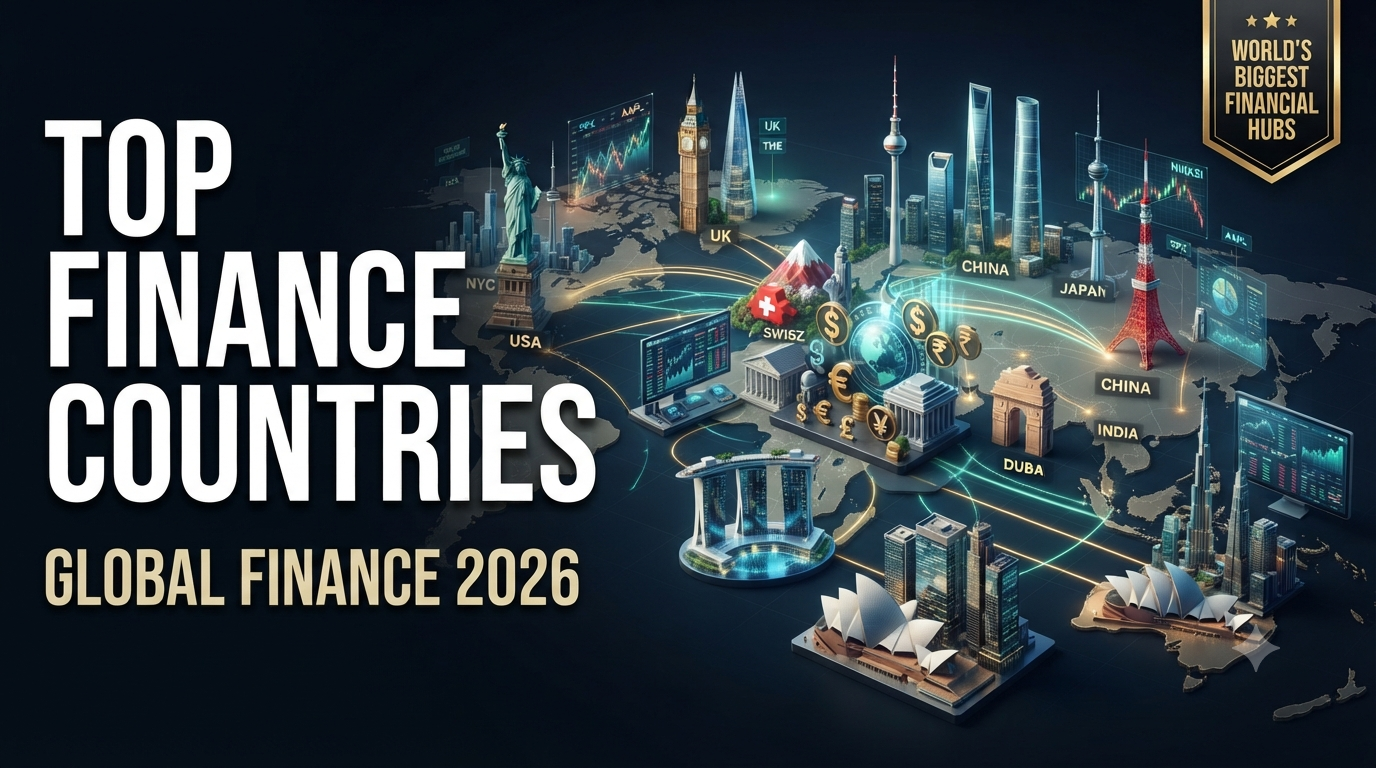
Top Finance Countries in the World: Leading Global Financial Markets and Economic Hubs
Finance is one of the most important parts of the global economy. Every day, billions of dollars move through stock markets, banks, investment funds, foreign exchange markets, bond markets, payment systems and other financial institutions.
Some countries have developed especially strong financial systems and international financial centres. These countries attract investors, banks, multinational companies and financial institutions from around the world.
The United States and United Kingdom remain the two most important truly global financial centres by measured market activity, according to the 2026 New Financial International Financial Centres Index. Hong Kong is another major international financial hub, while Singapore has become one of Asia's most important financial centres.
This article explains some of the world's leading finance countries, what makes their financial systems important and why global investors pay attention to them.
1. United States
The United States is one of the world's most influential financial economies.
New York is a major global financial centre and is home to important stock exchanges, banks, investment firms, asset managers and financial institutions.
The US financial market is supported by a large economy, deep capital markets, major corporations and a highly developed banking and investment ecosystem.
Important areas of US finance include:
-
Stock markets
-
Investment banking
-
Asset management
-
Venture capital
-
Private equity
-
Banking
-
Insurance
-
Foreign exchange
-
Bond markets
-
Financial technology
The US dollar also plays a major role in international finance.
The size and liquidity of US financial markets mean that economic and monetary-policy developments in the country can have significant effects on global markets.
2. United Kingdom
The United Kingdom, particularly London, is another major global financial centre.
London has a long history as an international centre for banking, insurance, investment management, foreign exchange and financial services.
The UK's financial sector has a particularly strong international orientation. New Financial's 2026 research identifies the US and UK as the only two truly global financial centres based on its measure of market activity.
London's financial ecosystem includes:
-
International banks
-
Insurance companies
-
Asset managers
-
Investment firms
-
Foreign exchange markets
-
Legal and professional services
-
Fintech companies
London's location and international connections have helped it remain important to global finance.
3. China
China has become one of the world's largest economies and an increasingly important financial power.
Major financial centres include Shanghai, Shenzhen and Hong Kong.
China has large domestic capital markets, major banks, technology companies and a growing investment ecosystem.
The Chinese renminbi is also becoming more relevant in international financial activity. Recent market developments have included substantial growth in offshore renminbi borrowing, reflecting efforts to internationalize the currency.
China is particularly important in:
-
Banking
-
Manufacturing finance
-
Stock markets
-
Digital payments
-
International trade
-
Technology
-
Investment
The country's huge domestic market also makes its financial system important for global businesses.
4. Japan
Japan is one of Asia's most established financial economies.
Tokyo is a major financial centre with large banks, investment institutions, corporations and capital markets.
Japan has one of the world's largest developed economies and an important role in global investment.
The Japanese yen is also one of the world's major currencies.
Japan's financial markets are closely watched because changes in Japanese monetary policy can influence currency markets, bond markets and international investment flows.
Japan also has a significant institutional investment sector and large pools of domestic savings.
5. Singapore
Singapore is a relatively small country but has developed into one of the world's most important financial hubs.
Its strategic location in Southeast Asia makes it an important connection point between Asian and international markets.
Singapore is known for:
-
Banking
-
Wealth management
-
Asset management
-
Foreign exchange
-
Fintech
-
Insurance
-
Private banking
-
International business
Singapore is particularly attractive to financial institutions because of its developed infrastructure and strong position within the Asian economy.
The country has also become an important centre for financial technology and cross-border business.
6. Hong Kong
Hong Kong remains one of the world's major international financial centres.
Its financial importance is closely connected with international investment and its relationship with mainland China.
Hong Kong has strong capabilities in:
-
Banking
-
Capital markets
-
Asset management
-
Stock trading
-
Wealth management
-
International finance
New Financial's 2026 index places Hong Kong among the leading international financial centres after the US and UK.
Hong Kong also provides an important channel between international investors and China's financial markets.
7. Switzerland
Switzerland is famous for banking, wealth management and financial services.
Zurich and Geneva are important financial centres.
The country's financial sector has traditionally been associated with:
-
Private banking
-
Wealth management
-
Asset management
-
Insurance
-
International finance
Switzerland's financial reputation is supported by its developed economy, financial expertise and large wealth-management industry.
8. Germany
Germany is Europe's largest economy and has an important financial sector.
Frankfurt is the country's major financial centre and hosts important banks, financial institutions and European financial infrastructure.
Germany is especially important for:
-
Banking
-
Corporate finance
-
Insurance
-
Investment
-
European financial markets
Its position within the European economy makes German financial developments relevant to businesses and investors across the continent.
9. India
India is becoming increasingly important in global finance.
Mumbai is India's major financial centre and is home to major banks, financial institutions, stock exchanges and investment companies.
India's financial system includes:
-
Banking
-
Stock markets
-
Mutual funds
-
Insurance
-
Digital payments
-
Fintech
-
Investment services
India's digital payment ecosystem has also gained international attention. UPI has become one of the world's most significant instant payment systems, and discussions around cross-border payment connectivity continue to expand.
India's large population, growing economy and expanding digital-finance ecosystem make it an important emerging financial power.
10. Canada
Canada has a developed banking and financial system and Toronto is its major financial centre.
The country is known for:
-
Banking
-
Insurance
-
Investment management
-
Capital markets
-
Pension funds
-
Natural-resource finance
Canada has also been actively positioning itself to attract international investment. In 2026, the Canadian government launched a major investment campaign aimed at attracting global capital into infrastructure and other projects.
11. Australia
Australia is an important financial economy in the Asia-Pacific region.
Sydney is the country's leading financial centre.
Australia has developed financial markets covering:
-
Banking
-
Superannuation
-
Insurance
-
Investment management
-
Stock markets
-
Wealth management
Its strong links with Asian economies make Australia an important part of the wider Asia-Pacific financial network.
12. United Arab Emirates
The United Arab Emirates has developed into an important financial hub in the Middle East.
Dubai and Abu Dhabi have attracted international banks, investment firms and financial businesses.
The UAE has invested heavily in:
-
Financial services
-
Fintech
-
Wealth management
-
International business
-
Investment
-
Digital assets
Its geographical position between Europe, Asia and Africa gives it an important role in international business.
Why Are Financial Countries Important?
A strong financial centre can support economic growth by connecting businesses with capital.
Companies need money to expand, build factories, hire employees and develop new products.
Financial markets help connect:
Investors → Financial institutions → Businesses → Economic growth
Banks provide loans, stock markets provide access to capital, investment firms manage assets and payment systems allow money to move efficiently.
A strong financial system can therefore support both domestic economic activity and international investment.
What Makes a Country a Financial Power?
Several factors can contribute to a country's financial strength.
Large Economy
A large economy usually creates significant demand for banking, investment and financial services.
Strong Capital Markets
Active stock and bond markets can provide businesses with access to capital.
Banking System
Large and stable banks are an important part of a country's financial infrastructure.
International Investment
Countries that attract foreign investors can become important international financial hubs.
Technology
Fintech and digital payments are increasingly important in modern finance.
Regulation
Clear and effective financial regulation can increase confidence among businesses and investors.
Skilled Workforce
Finance requires professionals in banking, accounting, investment management, law, technology and risk management.
Global Finance Is Becoming More Connected
Financial markets are no longer isolated by country.
Money can move between countries through investment funds, banks, companies and other financial institutions.
This creates opportunities but also risks.
The IMF has highlighted that cross-border portfolio flows can provide investment opportunities for emerging markets while also making some economies more sensitive to changes in global investor sentiment.
For example, a major change in interest rates in one country can affect currencies, bonds, stocks and investment flows elsewhere.
This is why investors and policymakers monitor global financial developments closely.
The Future of Global Finance
The global financial system is continuing to change.
Digital payments, artificial intelligence, fintech, blockchain technology and digital assets are changing how financial services operate.
Emerging economies are also becoming more important.
India, Brazil, Indonesia, Mexico and other emerging markets are gaining greater importance in global trade and financial networks. IMF research has noted the increasing prominence of several emerging markets within global economic and financial networks.
At the same time, financial risks remain important.
Global markets can be affected by:
-
Inflation
-
Interest rates
-
Government debt
-
Geopolitical tensions
-
Currency movements
-
Commodity prices
-
Banking risks
-
Market volatility
The IMF's 2026 Global Financial Stability Report highlighted elevated financial stability risks linked to geopolitical tensions, inflation pressures and tighter financial conditions.
Final Thoughts
The world's leading finance countries play a major role in the global economy.
The United States and United Kingdom remain the leading truly global financial centres, while China, Japan, Singapore, Hong Kong, Switzerland, Germany, India, Canada, Australia and the UAE each have important financial roles.
However, financial strength is not determined by one factor alone. Stock markets, banks, investment flows, currencies, technology, regulation, economic size and international connections all contribute.
For investors and businesses, understanding these global financial centres can provide useful context when studying international markets.
As global finance becomes increasingly digital and interconnected, emerging financial hubs and technologies are likely to play an even greater role in the future.