Walk into any tea stall, vegetable market, or auto-rickshaw in an Indian city today, and you will almost certainly see a QR code taped somewhere. Digital payments have moved from being a convenience to being the default, even for transactions worth ten or twenty rupees. Yet this explosive growth has created a quieter problem that most users never think about: every single UPI transaction, no matter how small, has to travel through the full banking infrastructure — bank servers, the National Payments Corporation of India's switch, and two-factor authentication. For a five-rupee tea purchase, that is a lot of machinery to move a very small amount of money.
This is the exact problem UPI Lite was built to solve, and understanding it says a lot about where India's digital payments ecosystem is heading next.
What UPI Lite actually is
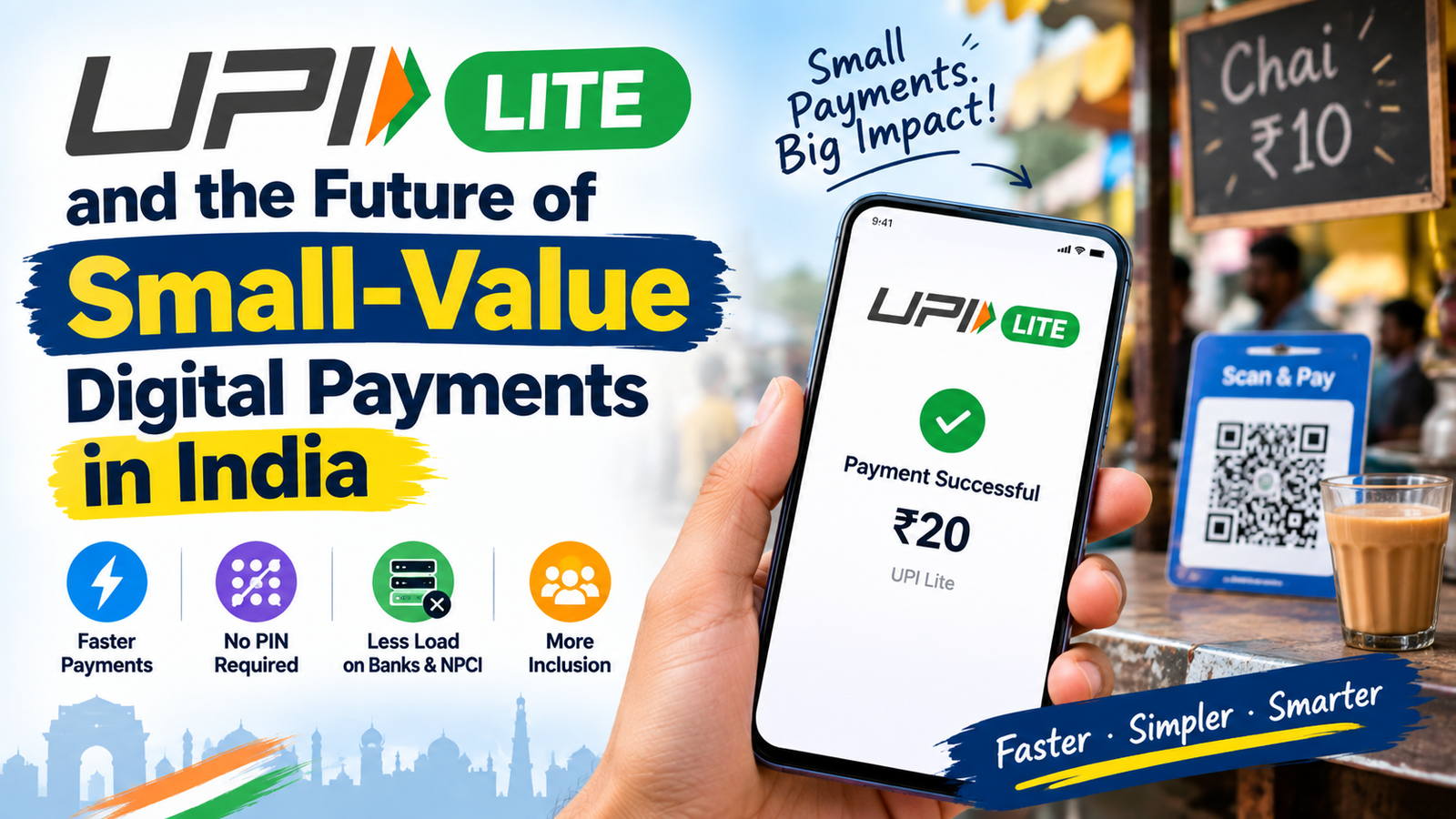
UPI Lite is a feature within the regular UPI apps — Google Pay, PhonePe, Paytm, and others — that lets users load a small amount of money, currently up to ₹2,000, into an on-device wallet. Payments made from this wallet, capped at ₹500 per transaction, don't require a UPI PIN and don't hit the bank's server in real time the way a normal UPI transaction does. Instead, they are processed locally and settled with the bank in batches later.
The practical effect is speed. A UPI Lite payment confirms almost instantly, even on a patchy network connection, because it isn't waiting on a round trip to a bank server and back. For small daily purchases — a cup of chai, a parking fee, a quick grocery top-up — this matters more than it sounds like it should.
Why small payments needed their own lane
To understand why this feature exists, it helps to look at what was happening to UPI's infrastructure before it. NPCI's switch handles an enormous and rapidly growing volume of transactions every month, and a significant chunk of that volume comes from payments under ₹200. Every one of these low-value transactions consumes the same server resources, the same authentication cycle, and the same settlement process as a payment of ₹50,000, even though the risk and reward profile is completely different.
As transaction volumes climbed into the billions per month, this became a real strain on the system, occasionally contributing to failed transactions during peak load, particularly around festivals or salary days when payment volumes spike sharply. UPI Lite essentially creates a separate, lighter-weight lane for the flood of tiny transactions, freeing up capacity on the main system and making the whole network more resilient.
There's a user-facing benefit too. Small UPI Lite payments don't need a PIN, which speeds up the checkout experience at high-footfall locations like transit systems, cafeterias, and street vendors, where every extra second in the queue matters.
How the technology actually works behind the scenes
It's worth understanding the mechanics a little more closely, because the design choices reveal a lot about the trade-offs involved. When a user adds money to their UPI Lite wallet, that amount is debited from their bank account in a single, standard UPI transaction and held in an on-device balance that is cryptographically linked to their bank account and UPI app. From that point on, individual payments made using the Lite balance are recorded locally on the device and don't require the bank's core system to authorise each one in real time.
Periodically, the app syncs these accumulated transaction records with the bank in a batch process, reconciling what has actually been spent against the wallet balance. This is fundamentally similar to how offline card payment terminals used to work before real-time authorisation became standard — transactions are provisionally trusted and verified in bulk later, rather than each one individually gating on a live server response.
This batching is precisely what removes the load from NPCI's central switch and from individual bank servers. Instead of a million five-rupee transactions each independently pinging the banking system, the system processes far fewer, larger reconciliation events. The trade-off, as discussed later, is that the money sits in a semi-detached state between being "in your bank" and being "spent," which requires the wallet to be treated carefully from a security and design standpoint even though the amounts involved are small.
How this fits into the bigger picture of financial inclusion
India's digital payments story is often told through the lens of smartphone-owning, urban, tech-comfortable users, but a large part of NPCI's actual strategy has been aimed at users who are none of those things. UPI Lite's design — no PIN required for small transactions, works with a lighter network load, faster confirmation — makes it noticeably more usable for people in areas with weaker mobile connectivity, and for users who find repeated PIN entry cumbersome or intimidating.
This connects to a broader set of tools NPCI has been rolling out alongside UPI Lite, including UPI 123Pay, which allows feature-phone users without internet access to make UPI payments through IVR calls and missed-call-based triggers, and UPI Lite X, which extends offline capability further by allowing device-to-device payments without any internet connection at the moment of transaction, using near-field communication. Together, these tools point toward a deliberate strategy: keep expanding who can use digital payments, not just how much volume the system can process.
This matters enormously in a country where large parts of the population, particularly in semi-urban and rural areas, still experience inconsistent 4G coverage. A payment system that assumes constant, reliable connectivity effectively excludes tens of millions of potential users. By building tools that degrade gracefully — working reasonably well even on a poor connection, or not requiring a connection at all — NPCI is addressing a structural gap that pure smartphone penetration numbers tend to obscure.
What this means for merchants
For small merchants, the shift toward UPI Lite is mostly invisible but genuinely useful. Faster transaction confirmation reduces the awkward pause at the counter where both the customer and the shopkeeper are staring at a phone screen waiting for a beep. Fewer failed transactions during high-traffic periods mean fewer disputes and fewer customers walking away because a payment didn't go through.
There is a settlement nuance worth understanding, though. Because UPI Lite transactions are batched rather than settled instantly, very large merchants who reconcile accounts multiple times a day may notice a short delay before Lite-based payments reflect fully in their bank statement compared to standard UPI transactions. For most small and medium merchants, this delay is a minor administrative detail rather than a practical problem, but it's worth knowing if you're building any kind of real-time reconciliation system around UPI transaction data.
Merchants running high-volume, low-ticket businesses — think canteens, small grocery stores, tea stalls, and parking operators — stand to benefit disproportionately from the broader system-wide reliability improvements that UPI Lite brings, even if they never think about the feature by name. Faster average transaction times across a full day of business, multiplied across hundreds of small sales, add up to a meaningfully smoother operating day.
Where UPI Lite has limitations
UPI Lite is deliberately narrow in scope, and it's worth being clear about what it doesn't do. It cannot be used to receive money — it is a payment-only wallet, meaning funds only flow out of it, not into it from another user. The ₹2,000 balance cap and ₹500 per-transaction cap mean it is not a substitute for regular UPI for anything beyond small daily spending. And because the wallet balance sits outside your regular bank balance until it's topped up, some users find the mental accounting slightly confusing at first — money moved into UPI Lite is technically no longer sitting in your bank account, even though it still belongs to you and can be transferred back.
There have also been isolated reports of UPI Lite balances not reflecting correctly during app updates or account migrations, which NPCI and banks have worked to resolve, but it's a reminder that a newer piece of financial infrastructure, however well-designed, takes time to reach full maturity across every device, app version, and bank integration.
Another limitation worth flagging is device dependency. Because the Lite balance is tied to the specific device and app installation, losing your phone or switching devices without properly migrating your UPI Lite wallet can create friction, even though the underlying money is never actually lost — it remains recoverable through the linked bank account with some additional steps. Users accustomed to the seamlessness of regular UPI, where everything lives on the bank's server and is accessible from any registered device, sometimes find this device-tied nature an unexpected wrinkle.
How UPI Lite compares to cash for small transactions
It's worth pausing on a comparison that doesn't get made often enough: how does UPI Lite actually stack up against cash for the small transactions it's designed to replace? Cash has always had one significant advantage for tiny purchases — it requires no device, no battery, no network, and no app. UPI Lite closes much of that gap by removing the PIN requirement and reducing network dependency, but it doesn't eliminate the need for a working, charged smartphone.
Where UPI Lite pulls ahead of cash is in record-keeping and hygiene. Every Lite transaction, despite being processed locally, still generates a transaction history within the app, giving users a far clearer picture of their small daily spending than a wallet full of loose change ever could. For a country increasingly interested in formalising its economy and improving financial transparency at every level, even small-value digital transaction trails carry meaningful long-term value, from personal budgeting to broader economic data.
For merchants, digital small-value payments also reduce the practical headaches associated with cash — the need to maintain change, the risk of handling errors, and the time spent counting and depositing physical currency at the end of a business day. These are not dramatic benefits individually, but across millions of small transactions daily, they represent a meaningful efficiency gain for India's retail economy.
Why this matters even if you never notice it
Most users will never consciously choose "pay with UPI Lite" — the feature usually activates automatically for small transactions once enabled, depending on the app. That's arguably the point. The best infrastructure improvements are the ones you don't have to think about; you simply notice that payments feel a little faster and fail a little less often, without knowing why.
For a country where UPI now processes tens of billions of transactions every month, and where a huge share of that volume comes from transactions under a hundred rupees, small architectural decisions like this compound into meaningful nationwide effects. Reduced server load benefits every user, not just the ones actively using UPI Lite, because it means the entire system has more headroom during peak periods.
What to expect next
NPCI has continued expanding UPI Lite's scope, gradually raising transaction and balance limits as the system has proven stable, and integrating it more tightly with offline and feature-phone payment tools. The broader direction is fairly clear: India's digital payments infrastructure is moving toward a tiered system, where small everyday transactions are handled through lightweight, fast, low-friction channels, while larger transactions continue to use the fuller security and verification process of standard UPI.
There is also a reasonable expectation that similar tiered architectures could eventually extend beyond peer-to-merchant payments into areas like recurring micro-subscriptions, in-app purchases, and machine-to-machine payments as India's digital economy grows more automated. The underlying principle — separating high-frequency, low-value activity from the heavier verification machinery used for larger transactions — is a pattern likely to show up in other parts of the financial system over time, not just in UPI itself.
For everyday users, the practical takeaway is simple. If your UPI app offers UPI Lite, it's worth enabling for the genuinely small, frequent payments that make up most of daily spending — the tea, the auto fare, the quick top-up — while keeping regular UPI for anything larger. It won't change how digital payments feel in any dramatic way, but it's one of several quiet upgrades making the system a little more resilient every year, one small transaction at a time.