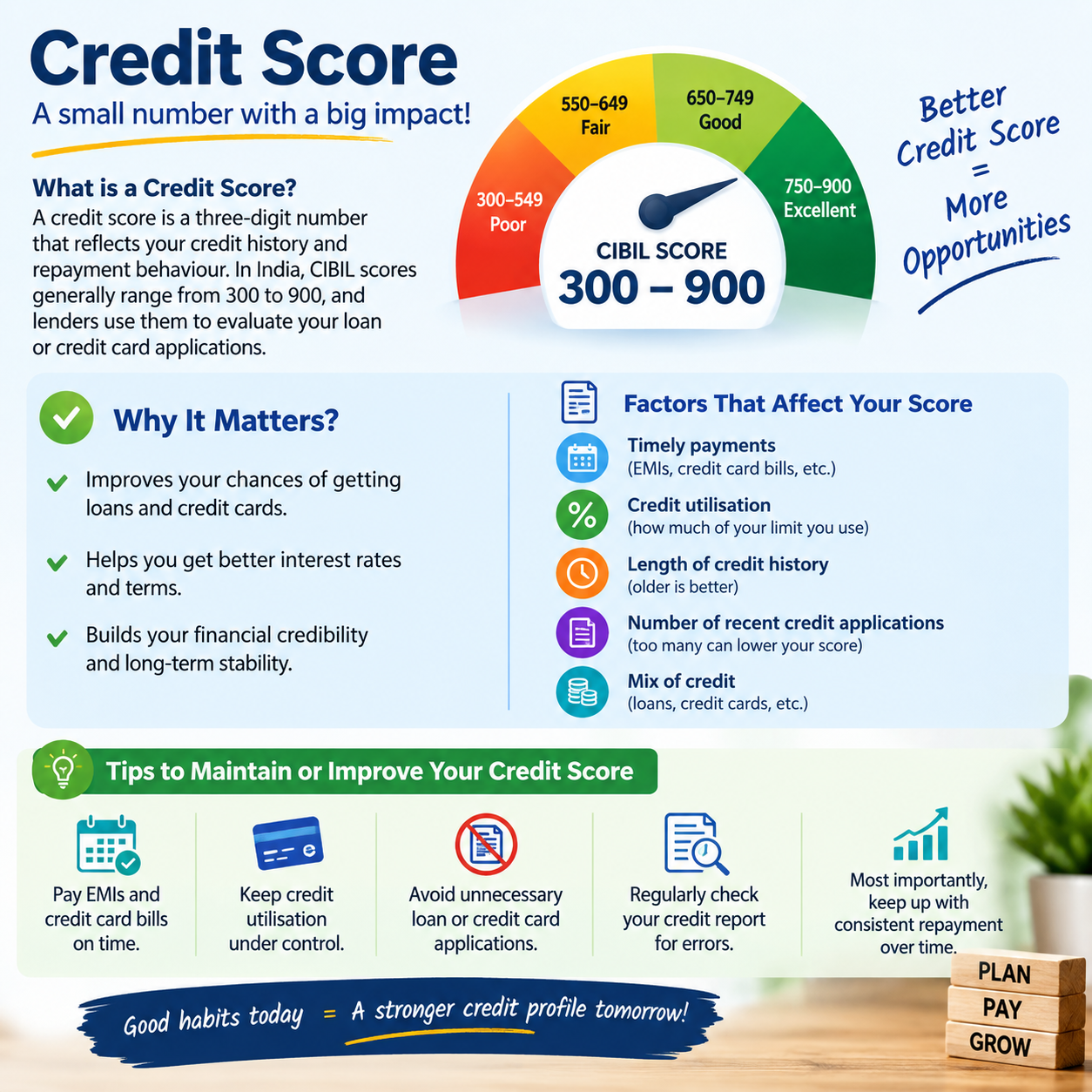
A credit score is one of the most important numbers in a person's financial life. It provides lenders with an indication of how an individual has managed credit in the past and how responsibly they have handled loans and credit cards.
In India, one of the best-known credit scores is the CIBIL Score, provided by TransUnion CIBIL. A CIBIL Score is a three-digit number ranging from 300 to 900. It is derived from information in a person's credit history, including loan accounts, credit cards, repayment behaviour and credit enquiries.
A credit score does not by itself guarantee loan approval. Lenders may also consider income, employment, existing liabilities, loan requirements and other aspects of the applicant's financial profile.
What Is a Credit Score?
A credit score is a numerical representation of an individual's credit history and repayment behaviour.
Whenever a person takes a loan or uses a credit card, information about the account and repayment behaviour may be reported to credit information companies. This information contributes to the person's credit report and, depending on the credit bureau and scoring model, to the credit score.
In India, major credit information companies include TransUnion CIBIL, Experian, Equifax and CRIF High Mark. The Government of India's MSME guidance notes that these companies collect credit-related information and generate credit reports and scores that lenders can use while assessing borrowers.
What Is a CIBIL Score?
The CIBIL Score is a three-digit numerical summary of credit history and ranges from 300 to 900. Generally, a score closer to 900 indicates a stronger credit profile from the perspective of credit scoring.
A CIBIL report can contain information such as:
- Active loan accounts
- Closed loan accounts
- Credit card accounts
- Payment history
- Outstanding amounts
- Credit enquiries
- Personal information associated with credit accounts
CIBIL states that consumers can obtain one free CIBIL Score and Report once per calendar year.
Why Is Credit Score Important?
Banks and financial institutions commonly review credit information when evaluating applications for loans and credit cards.
A credit score can influence the lender's assessment of credit risk. A stronger credit profile may make it easier for a borrower to qualify for credit and may contribute to better lending terms, although the final decision depends on the lender and the complete financial profile.
For example, a person applying for a home loan may have their credit history reviewed along with income, employment, existing loans, repayment capacity and documentation.
Therefore, maintaining a healthy credit profile can be useful when planning major financial commitments.
Main Factors That Affect a Credit Score
Credit scoring models are proprietary, and different credit information companies may use different methodologies. However, CIBIL identifies several important factors associated with credit scores.
1. Payment History
Payment history is one of the most important aspects of credit behaviour.
Paying EMIs and credit card bills on time demonstrates responsible repayment behaviour. Late payments, missed payments and defaults can negatively affect a credit profile.
For this reason, borrowers should keep track of payment due dates and maintain sufficient funds to meet scheduled payments.
2. Credit Utilisation
Credit utilisation refers to how much of the available revolving credit a person is using.
For example, suppose a credit card has a limit of ₹1,00,000 and the outstanding balance is ₹30,000. The utilisation is 30%.
High utilisation can indicate that a borrower is relying heavily on available credit. CIBIL advises consumers to keep credit utilisation low.
3. Length of Credit History
The age of credit accounts can also be relevant.
A longer history of responsibly managed credit provides more information about a person's borrowing and repayment behaviour. Older accounts with consistent repayment records can therefore contribute to a stronger credit profile.
However, consumers should not keep unnecessary accounts open solely for the purpose of increasing their credit history.
4. New Credit Enquiries
When a person applies for a loan or credit card, the lender may access the person's credit report.
A large number of credit applications within a short period can result in multiple enquiries and may affect the credit score. CIBIL recommends avoiding frequent credit applications unless the credit is genuinely required.
5. Credit Mix
A person's credit profile can contain different types of credit, such as secured and unsecured loans.
CIBIL's educational material discusses maintaining a healthy credit mix. However, people should not take unnecessary loans simply to create a particular mix of credit.
Credit Score and Credit Report: What Is the Difference?
Credit score and credit report are related but different.
A credit score is a numerical summary of credit history.
A credit report is a detailed record containing information about credit accounts, payment history, enquiries and other relevant credit information.
For example:
Credit Score: 780
Credit Report: Details of credit cards, home loans, personal loans, repayment history, outstanding balances and recent enquiries.
The report provides the underlying information, while the score provides a numerical summary.
How to Improve Your Credit Score
Improving a credit score generally requires consistent financial behaviour rather than a quick fix.
Pay EMIs on Time
Always make loan and credit-card payments before the due date. Setting up automatic payments or reminders can help prevent accidental delays.
Keep Credit Card Balances Under Control
Avoid consistently using a very high percentage of your available credit limit.
Paying the total credit-card bill, when financially possible, can also help avoid unnecessary interest charges.
Avoid Unnecessary Loan Applications
Do not apply for several loans or credit cards simply to compare offers.
Multiple credit applications within a short period can result in multiple lender enquiries.
Monitor Your Credit Report
Regularly reviewing your credit report can help identify incorrect information, unfamiliar accounts or enquiries that you did not initiate.
CIBIL specifically advises consumers to check their reports for accuracy.
Correct Errors Quickly
If you discover incorrect information in your credit report, contact the relevant lender and credit information company and follow the applicable dispute-resolution process.
An incorrect account, payment status or enquiry can create confusion in a credit report, so it is important to investigate unfamiliar information.
Maintain Responsible Credit Behaviour
Credit improvement is generally a long-term process.
Consistently paying obligations on time, keeping credit utilisation under control and avoiding unnecessary borrowing can help establish a stronger credit history.
Common Credit Score Myths
Myth 1: Checking Your Own CIBIL Score Reduces Your Score
Checking your own CIBIL Score does not negatively affect the score. CIBIL specifically states that self-checking does not impact the score.
Myth 2: Closing Every Credit Card Improves Your Score
Closing a credit card does not automatically improve a credit score. Closing an account can also change the available credit and the age of the credit relationship.
Any decision to close an account should therefore be based on the person's financial circumstances rather than the assumption that closing it will automatically increase the score.
Myth 3: A High Salary Automatically Means a High Credit Score
Income and credit score are different concepts.
A person can have a high income but a poor repayment record, while another person with a moderate income can have a strong repayment history.
Credit scoring primarily reflects information contained in the credit history.
Myth 4: Taking More Loans Will Automatically Increase the Score
Taking unnecessary loans is not a reliable way to improve a credit score.
Credit should be used according to genuine financial requirements and repayment capacity.
Myth 5: There Is Only One Credit Score
Different credit information companies can produce scores using their own scoring methodologies. The Government of India notes that credit scoring models used by credit information companies are proprietary.
Credit Score for First-Time Borrowers
People who have never taken a loan or credit card may have limited or no credit history.
This does not necessarily mean that the person has a bad credit profile. It may simply mean that there is insufficient credit information to evaluate past borrowing behaviour.
A first-time borrower should therefore focus on responsible use of any credit obtained, making payments on time and avoiding excessive borrowing.
Credit Score and Home Loans
A credit score can be particularly relevant when applying for a home loan because the loan amount is usually substantial and the repayment period can extend over many years.
Lenders may examine the applicant's credit history together with income, employment, existing liabilities, property details, repayment capacity and other criteria.
Maintaining a healthy credit profile before applying for a home loan can therefore be useful.
Credit Score and Personal Loans
Personal loans are generally unsecured loans, meaning they are not backed by a specific asset such as a house or vehicle.
Because the lender does not have the same type of collateral protection available with a secured loan, the applicant's credit profile can be an important part of the assessment.
Borrowers should compare the interest rate, processing fees, repayment period and total cost before accepting a personal loan.
Credit Cards and Credit Score
Credit cards can be useful financial tools when managed responsibly.
Responsible credit-card usage includes:
- Paying bills on time
- Avoiding excessive utilisation
- Understanding interest charges
- Monitoring transactions
- Avoiding unnecessary cash withdrawals
- Reviewing statements regularly
- Reporting suspicious transactions
A credit card should not be viewed as additional income. It represents borrowed money that must eventually be repaid.
What Can Damage a Credit Profile?
Several behaviours can negatively affect a credit profile, including:
- Missing EMI payments
- Delaying credit-card payments
- Defaulting on loans
-
- Maintaining very high credit utilisation
- Applying for several credit products in a short period
- Allowing incorrect information to remain unresolved
- Taking on debt beyond repayment capacity
The exact effect depends on the individual's credit history and the scoring model used.
How Often Should You Check Your Credit Report?
Regular monitoring can help consumers understand their credit position and identify errors.
CIBIL currently states that consumers are entitled to one free CIBIL Score and Report per calendar year.
Checking a report periodically can help identify:
- Unknown loan accounts
- Unknown credit-card accounts
- Incorrect payment records
- Unexpected enquiries
- Incorrect personal details
- Accounts that should have been closed
What Should You Do If You Find an Unknown Enquiry?
If an enquiry appears on your CIBIL report that you do not recognise, CIBIL advises consumers to contact the lender and, where appropriate, raise a dispute with CIBIL.
This is particularly important because unfamiliar enquiries or accounts could indicate incorrect reporting or potential misuse of personal information.
Credit Score and Financial Discipline
A credit score is ultimately connected to financial behaviour.
People who borrow within their means, make payments on time and monitor their credit information are better positioned to understand their financial profile.
However, a credit score should not become the only measure of financial health. Emergency savings, insurance, income stability, investments, debt levels and overall budgeting are also important parts of personal financial planning.
Conclusion
A credit score is an important component of modern financial management. In India, the CIBIL Score ranges from 300 to 900 and summarises information from a person's credit history.
Payment history, credit utilisation, credit history, credit enquiries and other elements of credit behaviour can influence a credit score.
The most effective approach is not to chase a particular number through unnecessary borrowing. Instead, consumers should focus on responsible credit management: pay dues on time, keep credit usage under control, avoid unnecessary applications, monitor credit reports and correct inaccurate information.
A healthy credit profile can make future borrowing easier to understand and potentially improve access to credit when it is genuinely needed.
- CIBIL score and its range
-
A score closer to 900 generally represents a stronger credit history, while 300 is the lowest possible CIBIL score. However, lenders consider other factors such as income, existing debt, repayment capacity and their own lending policies before approving credit.
Important: These descriptive bands are commonly used for educational purposes; CIBIL itself does not officially assign these exact categories to every score range.
- A credit score is a three-digit number that represents a person's credit history and repayment behaviour. In India, the CIBIL Score is one commonly used credit score and ranges from 300 to 900.
- Timely repayment of EMIs and credit-card bills
- Credit utilisation
- Length of credit history