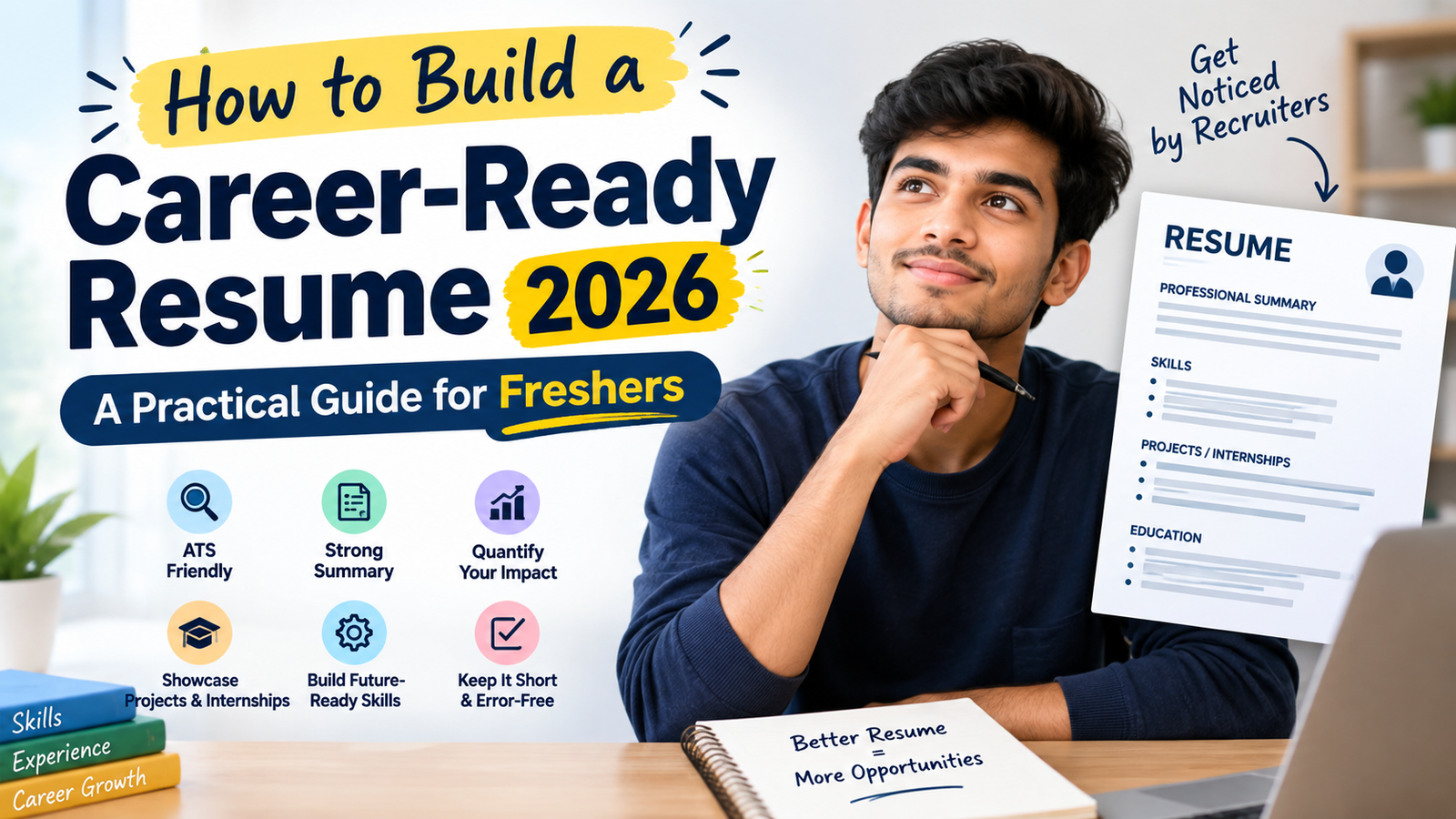
Every year, millions of students in India step out of college with a degree in hand and a resume that looks almost exactly like everyone else's. Same template, same font, same phrases — "hardworking team player with excellent communication skills." Recruiters read hundreds of these a week, and most of them get about six seconds of attention before a decision is made about whether to read further or move to the next application.
If you are a fresher trying to get your first interview call, your resume is not a formality you fill out because HR asked for it. It is your only sales pitch before anyone has met you, heard you speak, or seen your work. In a job market where a single opening can attract hundreds of applicants within hours of being posted, the difference between getting shortlisted and getting ignored often comes down to how well that one document is built. Here is a detailed, practical guide to building a resume that actually works in 2026.
Understand who reads it first — and it usually isn't a human
Before a human being ever lays eyes on your resume, software often does. Most mid-sized and large companies now rely on an Applicant Tracking System, commonly called an ATS, to filter incoming applications. This software scans your document for keywords pulled directly from the job description and ranks or filters candidates based on how closely their resume matches those terms. If the right words are missing, your application may never reach a human recruiter at all, no matter how qualified you actually are.
The fix for this is simple in concept but tedious in practice: read the job posting carefully, line by line, and mirror its language wherever it genuinely applies to you. If a listing asks for "data analysis using Excel and SQL," those exact terms should appear somewhere in your resume — assuming, of course, that you actually possess those skills. Never fabricate keywords for skills you don't have, because that gap will surface quickly in an interview.
Formatting matters just as much as vocabulary here. Tables, text boxes, headers, footers, columns, and decorative graphics often confuse ATS parsers, causing sections of your resume to be skipped entirely or scrambled into unreadable text. A single-column layout using a standard, widely supported font like Calibri, Arial, or Georgia is far safer than an elaborate designer template, however attractive it looks to the human eye. Save the file as a PDF unless the application specifically requests a Word document, since PDFs preserve formatting consistently across different systems.
Lead with what you have done, not what you are hoping for
A fresher's natural instinct is to open the resume with an objective statement: "Seeking a challenging role in a reputed organisation where I can utilise my skills for mutual growth." This sentence tells a recruiter absolutely nothing useful. It doesn't say what you're good at, what you've accomplished, or why anyone should keep reading.
Replace the objective with a two- to three-line professional summary that states your field, your strongest skill, and one concrete achievement or credential. This section sits at the very top of the page and functions as your elevator pitch in written form.
Compare these two openings. The first: "B.Com graduate looking for opportunities in finance." The second: "B.Com graduate with hands-on experience in GST filing and Tally, having managed accounts for a 40-vendor retail business during a six-month internship." The second version immediately gives a recruiter a reason to keep reading, because it demonstrates capability rather than merely expressing hope.
Quantify everything you possibly can
Numbers create credibility in a way that adjectives never do. Recruiters are trained to be skeptical of vague self-praise, but they respond to specific, measurable outcomes. Instead of writing that you "handled social media for a college fest," write that you "grew the event's Instagram following from 300 to 2,400 in eight weeks, contributing to over 1,100 event registrations." Instead of "assisted in customer support," write "resolved an average of 35 customer queries per day with a 92 percent satisfaction rating across 500-plus interactions."
Freshers often protest that they have no numbers worth sharing because they haven't held a "real job" yet. In almost every case, this isn't true — they simply haven't looked hard enough. Useful numbers can come from attendance figures at an event you organised, the size of a team you coordinated, the duration of a project, your marks percentile in a relevant subject, the number of clients or customers you interacted with, the hours you volunteered, or the budget you managed, however small. Sit down and reconstruct your last two years activity by activity, and the numbers will surface.
Treat internships, projects, and volunteer work as real experience
If you have no full-time job history, your academic projects, internships, freelance work, part-time jobs, and volunteer roles are your experience section, and they deserve to be written with the same seriousness as a paid position. Describe each one the way you would describe a job: what the problem or objective was, what specific actions you took, what tools or methods you used, and what measurable result followed.
A final-year engineering project, for instance, becomes far more compelling when written as: "Designed a low-cost water quality sensor using Arduino and pH probes; tested across 12 local wells over three months and presented findings to the municipal engineering department, leading to a follow-up pilot study." That single sentence tells a story of initiative, technical skill, and real-world impact. Compare it to "Made a water sensor project for final year," which communicates almost nothing about your capability.
The same logic applies to internships. Rather than listing generic duties like "assisted the marketing team," break down what you specifically contributed: which campaigns you worked on, what platforms you used, what results followed, and what you learned that you can now apply elsewhere. Recruiters are far more interested in outcomes and ownership than in job titles.
Build a skills section that reflects 2026's job market
The skills section deserves genuine thought this year, because the nature of valuable skills has shifted considerably. Artificial intelligence tools now handle a large share of routine drafting, formatting, basic coding, and first-pass data analysis across almost every industry. As a result, employers are less impressed by familiarity with basic software and increasingly interested in whether you can direct these tools effectively, verify their output critically, and apply sound judgement where automation falls short.
Practical additions worth considering for your skills section in 2026 include prompt writing and structured AI tool workflows, basic data literacy and spreadsheet modelling, familiarity with how automation is reshaping your specific industry, and any domain-specific software relevant to your field, whether that's Tally for accounting, Canva or Figma for design, or Python and SQL for analytics roles. Certifications from recognised platforms like Coursera, Google, or industry bodies carry some weight and are worth listing, but a small portfolio of real, demonstrable work — a GitHub repository, a writing portfolio, a design case study, a spreadsheet dashboard — carries considerably more.
Avoid padding this section with vague, unverifiable soft skills like "leadership" or "good communication" listed as standalone bullet points. These claims mean little without evidence. If you genuinely have strong communication skills, let that come through in how you describe your achievements elsewhere, rather than stating it outright.
Structure the page for a six-second scan
Recruiters typically scan a resume before they ever read it properly. Your layout needs to support that scanning behaviour rather than fight it. Use clear section headers — Summary, Experience, Projects, Education, Skills — in that rough order of priority for most freshers, since employers usually care most about what you can actually do, followed by what you know academically.
Within each section, use short bullet points rather than dense paragraphs, and begin each bullet with a strong action verb: built, managed, designed, analysed, negotiated, coordinated. Avoid starting every line with "Responsible for," which is passive and forgettable. Keep bullets to one or two lines each; if a point requires three lines to explain, it likely needs to be broken into two separate bullets or simplified.
White space is not wasted space. A page with generous margins and clear breathing room between sections is easier to scan and signals a level of polish that a cramped, text-heavy page does not.
Common mistakes that quietly sink strong candidates
Even capable freshers with genuinely good projects and internships often lose out because of small, avoidable mistakes rather than a lack of substance. One of the most frequent is using an unprofessional email address left over from school days — something like sitting at the top of an otherwise solid resume undermines the whole document instantly. Create a simple email using your name before you start applying anywhere.
Another common error is listing responsibilities instead of results. "Worked on marketing tasks" describes a duty; it doesn't tell a recruiter whether you did that duty well. Every bullet point should answer an unspoken question: so what happened because of this? If a line doesn't lead to an outcome, rewrite it or cut it.
Overly long education sections are another frequent issue among freshers, who sometimes list every school attended since childhood. Once you're applying for jobs, your schooling before the final two years of higher education is rarely relevant and can usually be trimmed to a single line or removed entirely, making room for the experience and skills sections that matter more.
Generic file names are a smaller but surprisingly common mistake — submitting a file called "Resume_Final_Final2.pdf" looks careless next to a file named clearly as "Firstname_Lastname_Resume.pdf." Recruiters handling dozens of applications notice these small signals of attention to detail.
Finally, many freshers undersell relevant coursework or academic projects because they assume "real" experience only comes from paid internships. In fields like engineering, data science, and design, a strong final-year project or a well-documented personal project can carry as much weight as a short internship, provided it's described with the same specificity and outcome-focus covered earlier in this guide.
Keep it to one page, and cut anything that doesn't earn its place
For a fresher, one page is the standard, and exceeding it usually signals padding rather than depth of experience. Two-page resumes are appropriate for candidates with several years of professional history, not for someone entering the workforce. If your draft is running long, look for redundant phrasing, remove less relevant coursework, and combine similar bullet points.
Certain details no longer belong on a modern resume and should be removed entirely: your photograph, date of birth, father's name, marital status, religion, and full postal address are unnecessary in most applications today and take up space your achievements need far more. A city and state, along with a phone number and professional email address, are sufficient contact information. A LinkedIn profile link and, where relevant, a portfolio or GitHub link are worth including instead.
Proofread with real discipline
Spelling errors, inconsistent verb tenses, and misaligned formatting are among the fastest ways to lose a recruiter's confidence, and they are entirely avoidable with a bit of discipline. Once your draft feels complete, read it aloud slowly from start to finish; awkward phrasing and missed errors tend to surface far more easily when heard rather than silently skimmed.
It also helps enormously to have at least one other person — a senior, a mentor, or someone already working in your target field — review the resume before you send it out. A fresh set of eyes will catch inconsistencies you have become blind to after staring at the same document for hours, and they may also flag phrasing that sounds unclear or unconvincing to someone outside your own head.
Check for consistency in small details too: if one bullet point is in past tense, all bullets describing completed work should be in past tense; if you use periods at the end of some bullets, use them consistently throughout. These details are minor individually but add up to an impression of carelessness if ignored.
Tailor the resume for every application, not just once
A resume is not a document you write once and reuse forever for every job you apply to. The strongest candidates maintain a detailed master file listing every project, internship, skill, achievement, and number they have accumulated, and then build a tailored, condensed, one-page version for each specific application, pulling in the details most relevant to that particular role and rewording the summary to match the job description's language.
This might sound time-consuming, but in practice it takes about fifteen extra minutes once your master file exists. Those fifteen minutes are very often the difference between silence and an interview call, because a tailored resume signals genuine interest in that specific role, while a generic one signals a mass-application approach that most recruiters can spot immediately.
A final word
Building a strong resume as a fresher is less about clever formatting tricks and more about honest, specific self-assessment. It requires sitting down and genuinely reconstructing everything you have done over the past two or three years, finding the numbers and outcomes hidden inside ordinary-sounding activities, and presenting them with clarity and confidence rather than vague generalities.
Start today. Open a blank document, list everything you have done in the last two years without editing yourself, and build outward from there. The resume that gets you your first interview call rarely comes from a template — it comes from the specific, honest detail you're willing to dig for.