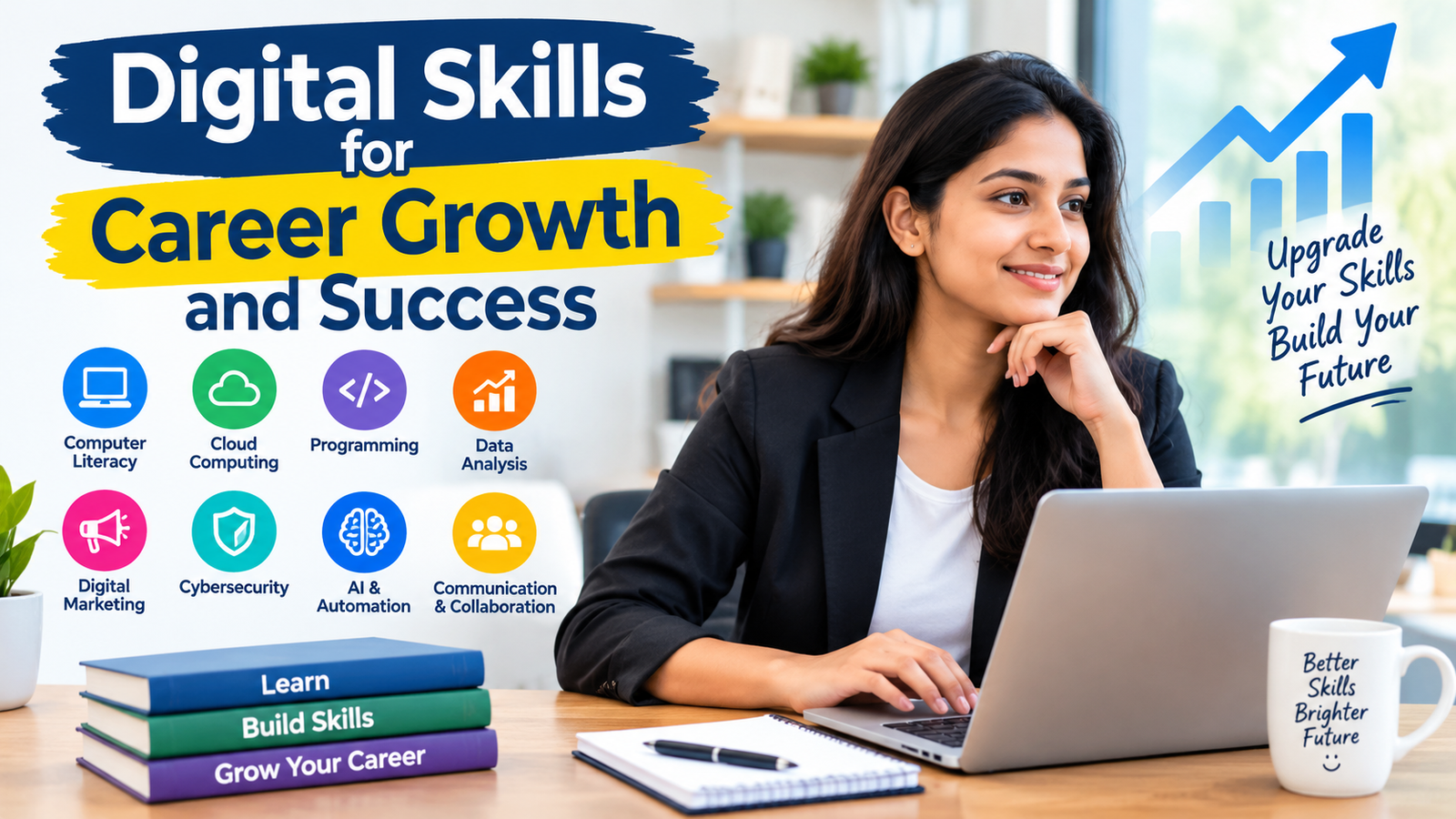
Bilkul 👍 Neeche “Digital Skills for Career Growth and Success” par 2000+ words ka original article hai. Isko aap direct Article Content box mein copy-paste kar sakte ho.
Digital Skills for Career Growth and Success
Introduction
The modern workplace is becoming increasingly connected to digital technology. Computers, smartphones, cloud platforms, online communication tools, business applications, artificial intelligence, and digital services are now used across many industries. Because of this transformation, digital skills have become an important part of professional development.
Digital skills are not limited to programming or advanced technical knowledge. They include the ability to use computers, communicate through digital platforms, search for reliable information, manage files, work with online tools, protect accounts, analyze information, and adapt to new technologies. Depending on a person's career, digital skills can range from basic computer literacy to specialized abilities such as coding, data analysis, digital marketing, cloud computing, cybersecurity, and artificial intelligence.
Developing digital skills can help people become more comfortable with modern workplaces and changing technologies. Students can use these skills while preparing for careers, while professionals can use them to improve productivity and adapt to new responsibilities.
The digital world continues to evolve, so learning should also be continuous. A person does not need to master every technology. Instead, developing strong fundamentals and the ability to learn new tools can provide a useful foundation for long-term career development.
What Are Digital Skills?
Digital skills are abilities that allow people to use digital devices, software, platforms, and online services effectively and responsibly.
Basic digital skills include using a computer, creating documents, sending emails, browsing the internet, managing files, using spreadsheets, and participating in online meetings.
Intermediate skills may include website management, digital content creation, social media management, data visualization, online collaboration, and using specialized business applications.
Advanced digital skills can include programming, software development, cloud computing, machine learning, cybersecurity, data science, automation, and database management.
Different careers require different combinations of these skills. A marketing professional may need social media and analytics skills, while a software developer may require programming and database knowledge.
The important thing is to identify which digital abilities are relevant to a person's specific goals.
Why Digital Skills Matter in Modern Careers
Digital technology is now involved in many everyday workplace activities. Employees may use software to communicate with colleagues, manage customer information, prepare reports, schedule tasks, or complete administrative work.
Even jobs that are not traditionally considered technology jobs may require some level of digital knowledge.
For example, a sales professional may use customer relationship management software. An accountant may work with accounting applications and spreadsheets. A designer may use digital design software. A teacher may use online learning platforms. A business owner may use websites, payment systems, and social media.
As workplaces become more digital, employees who understand relevant tools can often complete tasks more efficiently.
Digital skills also make it easier to adapt when organizations introduce new systems or processes.
Basic Computer Literacy
Basic computer literacy is the foundation for many digital skills.
People should be comfortable using common computer functions such as creating and organizing folders, managing files, installing updates, using browsers, and working with documents.
Understanding common software such as word processors, spreadsheets, presentation tools, and email applications can also be useful.
These skills may appear simple, but they form the foundation for more advanced digital abilities.
Someone who is comfortable with basic computer operations can usually learn specialized software more easily because they already understand common digital concepts.
Students and beginners can therefore start by developing strong basic computer knowledge before moving toward specialized technologies.
Communication Skills in the Digital Workplace
Digital communication has become an important part of professional life.
Employees may communicate through email, instant messaging, video conferencing, project management platforms, and other collaboration tools.
Effective digital communication requires more than knowing how to use an application. People also need to understand how to communicate clearly and professionally.
Emails should have clear messages and appropriate language. Online meetings require participants to listen carefully and communicate respectfully. Workplace messages should provide enough information without creating unnecessary confusion.
Learning how to choose the right communication method is also important. A short message may be suitable for a quick update, while a detailed discussion may be better handled through a meeting or formal document.
Strong digital communication can support teamwork and reduce misunderstandings.
Productivity and Time Management Tools
Digital tools can help people organize their work.
Calendar applications can be used to schedule meetings and deadlines. Task-management platforms can help employees track responsibilities. Notes applications can organize information, while spreadsheets can be used to manage lists and data.
Learning how to use these tools effectively can improve organization.
However, having many applications does not automatically improve productivity. People need to understand which tools are actually useful for their work.
A simple system can often be more effective than using many complicated applications.
For example, a professional might use a calendar for appointments, a task manager for daily responsibilities, and cloud storage for documents.
Digital Research Skills
The internet provides a huge amount of information, but not all information is equally reliable.
Digital research skills involve finding relevant information, evaluating sources, comparing information, and identifying trustworthy material.
These abilities are useful in many careers.
An employee may need to research a market trend, investigate a technical issue, understand a customer question, or learn how a new software tool works.
Good research involves asking clear questions and checking information before using it.
Developing research skills can also help people become independent learners because they can find resources when they encounter unfamiliar topics.
Data and Spreadsheet Skills
Data is used by many organizations to understand operations and make decisions.
Basic spreadsheet skills can therefore be valuable across different careers.
People can use spreadsheets to organize information, perform calculations, create tables, track expenses, manage lists, and generate simple charts.
More advanced users can learn formulas, filters, pivot tables, data cleaning, and visualization.
Data skills do not necessarily require advanced mathematics. Understanding how to organize and interpret information can already provide practical value.
Professionals who become comfortable working with data may be able to communicate information more clearly and identify patterns within their work.
Digital Marketing Skills
Digital marketing has created new ways for businesses to communicate with customers.
Websites, search engines, social media, email marketing, online advertising, and content platforms are commonly used as part of digital marketing strategies.
People interested in marketing can learn skills such as search engine optimization, content creation, social media management, analytics, email marketing, and basic advertising concepts.
Digital marketing also requires creativity and communication. Technology provides the tools, but successful communication still depends on understanding audiences and presenting useful information.
These skills can be relevant to businesses of different sizes, including small businesses and online entrepreneurs.
Web Development Skills
Web development is another important digital skill area.
Websites are used by businesses, educational institutions, organizations, creators, and individuals.
Beginners can start by learning HTML and CSS to understand how web pages are structured and styled. They can then explore JavaScript and other technologies as their knowledge develops.
Web development also introduces useful concepts such as databases, hosting, version control, APIs, and security.
Practical projects can make the learning process more effective. A beginner might create a personal portfolio website, a small business website, or a simple information page.
A collection of completed projects can demonstrate practical abilities to potential employers or clients.
Cloud Computing Skills
Cloud computing allows organizations to access computing resources and services through internet-based platforms.
Businesses use cloud technologies for applications, storage, databases, websites, backups, and many other purposes.
People interested in technology careers can explore concepts such as virtual machines, cloud storage, networking, databases, containers, and cloud security.
Popular cloud platforms provide many different services, so beginners should first understand fundamental concepts before trying to learn everything.
Cloud skills can be especially relevant to careers involving software development, system administration, infrastructure, and DevOps.
Cybersecurity Awareness
As more professional activities move online, cybersecurity becomes increasingly important.
Every digital user should understand basic security practices.
These include using strong passwords, avoiding suspicious links, protecting account credentials, enabling multi-factor authentication where available, and keeping software updated.
Professionals who work with sensitive information may need more advanced security knowledge.
Cybersecurity is not only the responsibility of a specialized security team. Everyday employee behavior can influence an organization's security.
Developing basic cybersecurity awareness can therefore be useful for almost anyone who works with digital systems.
Artificial Intelligence Skills
Artificial intelligence is becoming increasingly relevant across many industries.
AI tools can assist with tasks such as generating ideas, summarizing information, analyzing content, organizing work, and supporting certain business processes.
Learning how to use AI responsibly can become a useful digital skill.
However, users should understand the limitations of AI systems. AI-generated information may contain mistakes, and sensitive or confidential information should not be shared with tools unless appropriate permission and safeguards are in place.
A useful AI skill is the ability to evaluate output rather than simply accepting it.
People can also learn how to write clear instructions, review results, verify important information, and combine AI assistance with human judgment.
Adaptability and Continuous Learning
Technology changes quickly. A tool that is popular today may be replaced or significantly changed in the future.
This makes adaptability an important career skill.
Instead of trying to memorize every technology, professionals can focus on understanding fundamental concepts and developing the ability to learn.
For example, someone who understands basic programming concepts may be able to learn a new programming language more easily. Someone who understands digital marketing principles can adapt when a social media platform changes its features.
Continuous learning can therefore be more valuable than relying only on existing knowledge.
Building Digital Skills Through Projects
Practical projects are one of the most effective ways to develop digital abilities.
A person learning spreadsheets can create a budget tracker. Someone learning web development can create a website. A beginner in digital marketing can develop a sample marketing plan. Someone interested in data can practice analyzing a dataset.
Projects provide opportunities to apply concepts and discover areas that require more practice.
They also help build a portfolio.
A portfolio can demonstrate practical work to employers, clients, or collaborators. Instead of simply saying that a person has a particular skill, a portfolio can show examples of how that skill has been used.
Certifications and Digital Learning
Online courses and certifications can support skill development.
A structured course can provide a clear learning path and help beginners understand important concepts.
Certifications may also demonstrate that a person has completed a particular training program or assessment.
However, certificates should not replace practical knowledge.
Someone may complete a course but still need experience applying the concepts. Combining structured learning with projects and practice can create a stronger learning experience.
Learners should choose educational resources based on their goals and the relevance of the content to their intended career.
Digital Skills for Students
Students have a strong opportunity to develop digital skills before entering the workforce.
They can start with basic computer knowledge and gradually explore areas connected to their interests.
For example, a student interested in business may study spreadsheets, presentations, digital marketing, and communication. A technology-focused student may explore programming, databases, cloud computing, or cybersecurity.
Students can also use digital tools to create projects related to their studies.
Developing a portfolio while studying can help students demonstrate practical abilities later.
The goal should be to combine academic knowledge with practical digital experience.
Digital Skills for Career Changers
Digital skills can also be useful for people considering a career change.
A person does not necessarily need to start from zero. Existing professional experience can often be combined with new digital abilities.
For example, someone with sales experience could learn digital marketing or customer relationship management tools. A person with administrative experience could develop spreadsheet, project management, or data skills.
Combining existing knowledge with new technology skills can create a unique professional profile.
Career changers can begin by researching the skills commonly required in their target field and then creating a realistic learning plan.
How to Create a Digital Skills Learning Plan
A learning plan can make skill development easier.
First, identify a clear career goal. For example, a person may want to become a web developer, digital marketer, data analyst, or technology support professional.
Next, identify the skills required for that goal.
Then divide those skills into beginner, intermediate, and advanced topics.
Choose reliable learning resources and create a regular study schedule.
After learning each concept, practice it through a small project.
Finally, review progress regularly and identify areas that need additional practice.
A learning plan does not need to be complicated. A simple and consistent approach can be effective.
Common Challenges in Learning Digital Skills
Learning technology can sometimes feel overwhelming.
There are many programming languages, software applications, courses, platforms, and tutorials available. Beginners may not know where to start.
The solution is to avoid trying to learn everything at once.
Choose one skill and follow a structured path.
Another challenge is lack of confidence. Beginners may compare themselves with experienced professionals and feel that they are progressing slowly.
Everyone starts at a different level. Comparing progress with one's previous abilities can be more useful than comparing with others.
Another common problem is passive learning. Watching tutorials without practicing can create the feeling of learning without developing practical ability.
Regular hands-on work can help solve this problem.
The Importance of Soft Skills Alongside Digital Skills
Digital skills are valuable, but they work best when combined with soft skills.
Communication, teamwork, problem-solving, creativity, organization, and adaptability remain important in professional environments.
A person may know how to use advanced software but still need to communicate effectively with teammates and customers.
Digital tools can improve processes, but people still need to understand goals and make appropriate decisions.
Developing technical and soft skills together can create a more balanced professional skill set.
Staying Updated With Technology
Because technology changes regularly, professionals can benefit from staying informed.
They can follow reliable technology publications, official documentation, professional communities, educational resources, and industry discussions.
However, staying updated does not mean following every new trend.
People should focus on technologies that are relevant to their careers.
Learning every new application can waste time. Understanding which developments actually matter to a particular field is more useful.
Digital Skills and Professional Confidence
Developing digital skills can improve confidence in professional situations.
When employees understand the tools they use, they may feel more comfortable completing tasks and solving common problems.
Confidence does not mean knowing everything. It means being willing to investigate problems, ask questions, learn, and improve.
A professional who does not know how to use a new tool can learn it. A person who encounters an unfamiliar technical problem can research possible solutions.
This learning mindset can be valuable throughout a career.
The Future of Digital Skills
The demand for digital abilities is likely to continue evolving as technology develops.
Artificial intelligence, automation, cloud platforms, data systems, and digital communication are influencing many industries.
Future professionals may need to work alongside increasingly advanced technologies.
The exact tools will change, but some fundamental abilities will remain useful. These include digital literacy, problem-solving, communication, critical thinking, adaptability, and continuous learning.
People who develop these foundations can be better prepared to learn new technologies when they become relevant.
Conclusion
Digital skills have become an important part of modern career development. Technology is influencing how people communicate, manage information, complete tasks, collaborate with teams, and learn new abilities.
Digital skills include much more than programming. Basic computer literacy, online communication, productivity tools, research, spreadsheets, digital marketing, web development, cloud computing, cybersecurity, and artificial intelligence are examples of different areas people can explore.
The right skills depend on individual career goals. Students can use their education years to develop practical abilities and build projects. Professionals can learn tools related to their current roles or prepare for new opportunities. Career changers can combine existing experience with new digital knowledge.
The most important principle is continuous learning. Technology will continue to change, so people should focus not only on learning current tools but also on developing the ability to understand and adapt to new ones.
Practical projects, structured courses, reliable resources, and regular practice can make digital learning more effective. Combining technical abilities with communication, teamwork, creativity, and problem-solving can create a balanced professional skill set.
Digital technology will continue to influence the future of work. By developing relevant digital skills and maintaining a willingness to learn, individuals can build a stronger foundation for professional growth and adapt more confidently to an evolving workplace.